I have just settled into the booth of a chic city bar with an important work contact, when my phone rings.
It’s the proprietor of an after-school art class my six-year-old daughter recently started.
‘Um, your daughter is still here,’ she tells me, ‘and we’re closing soon.’
I’d agreed with my husband Tom that he would pick her up – so where is he?!
Unusually, there’s no reply to my urgent text. After some frantic messaging, I arrange for Sylvie to be collected by the babysitter of a mum friend before I make my excuses and race home.
Yet again, I am the one who has to do everything while Tom gets to behave like a single man with no responsibilities.
At 6.30pm, he bursts through the front door in his biking gear. ‘The park was empty today, it was so great!’ he says with a grin.
Then he stops, suddenly wary. I stand motionless, chest heaving, eyes unnaturally bright.
He has good reason to be afraid; I am furious and, in that moment, I hate him.
When I was around six months pregnant, a friend of mine had warned me to ‘get ready to hate your husband’.
At the time I had listed all the reasons why this wouldn’t happen to us: Tom and I had been together for nearly a decade. Mild-mannered freelance writers who worked from home, we were also older parents – I had Sylvie when I was 42 – and squabbling required reserves of energy that we no longer had.
But my friend was right.
From the earliest days of parenthood, when Tom would constantly say he’d empty the nappy bin ‘later’, my resentment was on a constant drip.
Six years on, I had the world’s tiniest fuse.
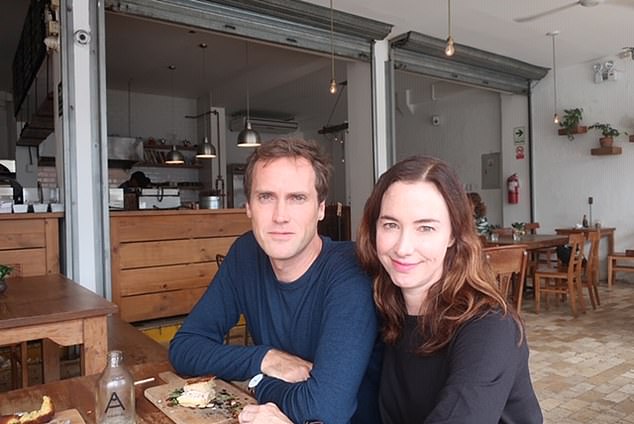
Jancee Dunn was warned during her pregnancy that she would start to hate her husband. Sure enough, from the earliest days of parenthood her ‘resentment was on a constant drip’

Research has found that 67 per cent of couples see their marital satisfaction plummet after having a baby
Tom found fighting unbearable; the moment my voice began to rise, he turned light grey and retracted into himself like a stunned snail.
While I threatened divorce and called him every name in the book, he never – I mean never – did the same to me.
It gave me no satisfaction to scream at a kind, gentle chess player who enjoyed reading and birdwatching in his spare time.
But I did it anyway, several times a week, about childcare, housework and money.
While pre-baby, we’d been a couple who split everything down the middle, after she was born we unintentionally slid backward into more traditional roles.
I was making food for Sylvie, so I started doing all the family cooking and food shopping. I did the baby’s laundry, so I began to throw in our clothes, too.
By the time Sylvie was starting school, Tom was doing about 10 per cent of the household chores – as if he were a guest at a hotel I was running.
At the weekends, he’d float around in a happy single-guy bubble – games of football, leisurely showers after a lie-in, arranging to meet friends. Meanwhile, I was ferrying our daughter to birthday parties and playdates.
Tom was kind and attentive to Sylvie but when I had to nag him to do a task I felt like his mother too. And I was constantly keeping score to see if he’d step up; he didn’t.
So, I’d yell – terms that had not crossed my lips since I was a teenager: A***hole. Piece of sh*t. Then he’d shut me out and ignore me.
Our situation was not unique. Get some mothers together, a few bottles of sauvignon blanc and the sniping will soon rise to a thunderous crescendo of complaint.
No wonder research has found that 67 per cent of couples see their marital satisfaction plummet after having a baby.
I realised something had to change when my shouting started causing our daughter to jump to Tom’s defence. By the time Sylvie was five, she would stand in front of him as if to protect him.
Ultimately my fear was that if our situation did not change, Tom and I wouldn’t stay together. So I set out to restore harmony to our marriage and family life.
I spoke to psychologists, marriage counsellors, therapists and even FBI hostage negotiators, who shared their research and gave advice.
It wasn’t the work of a weekend. It took more like 14 months for us to become a happy functioning couple. But ten years on, Sylvie is a teenager and Tom and I are contentedly married.
Sure, we still fight, but it doesn’t have the heat of the old days.
And our story has helped countless couples, with my book, How Not to Hate Your Husband After Kids, selling a quarter of a million copies worldwide. So read on to find out how not to hate yours, improve your marriage and restore your personal happiness…
STOP COMPARING HIM TO A WOMAN
With hindsight, I see my expectations of Tom probably increased because I spent so much time around other mums, who offer unthinking support.
Take the time Sylvie grazed her knee in the playground and one friend handed me a wad of tissues, another a plaster, a third a lollipop for Sylvie. All without a break in our conversation.
Tom, meanwhile, rarely seemed to notice I needed a hand and my resentment would build up.
My first helpful step on the path to real change was to stop waiting for him to react like my mum friends. He can’t read your mind. He very likely can’t figure out why you’re fuming. You’ve got to be clear in asking for what you want – or accept that you’ll stay angry.
IF A FIGHT IS BREWING, START WITH ‘I’
Beginning a statement with ‘I’ instead of ‘you’ (‘I feel like you’re not listening’ rather than ‘You’re not listening’) is a game changer.
Taking a pause to focus on how I’m feeling, rather than immediately resorting to criticism, makes me feel calmer and more in control. So does drawing a few deep breaths as I diagnose what one psychologist called the ‘soft emotions’ behind my anger.
Usually, I felt betrayed – what happened to the evolved guy I married? He used to handle all the cooking while I did the housework; we did groceries and laundry à deux.
Did Tom believe those in possession of a uterus are more suited to menial work? That my time mattered less than his?
Sometimes I was simply jealous that he felt no guilt about relaxing.
THE EFFORT IS WORTH IT FOR HIM TOO
Tom was understandably reluctant to give up his single-guy-within-a-family lifestyle. Why would he want to forgo long, carefree bike rides and three homemade meals a day?
But in the end he did so. Firstly to keep the peace. Then because, he later admitted, he’d been fully aware he was doing very little and that I was burnt out.
The more he did his share, the happier I was – a tangible benefit for him. The more he pulled his weight, the more likely we were to share jokes and kind words. And have sex.
I stopped falling asleep at 9pm from sheer exhaustion and even stayed up with him to watch the depressing Romanian films he liked.
JUST DO IT!
Like lots of couples, we had let our sex life slip, but I learned that it’s critical to observe the Nike slogan and ‘just do it’.
This isn’t about just pleasing your partner. Sex releases endorphins, as well as the cuddle hormone, oxytocin, which makes you feel good too.
One gynaecology professor told me: ‘In order to keep that relationship with your partner strong, you need to have physical intimacy. You just feel better about each other after you have sex!’
I proposed to Tom that we take up the challenge of an Evangelical preacher, who wrote a book about how to maintain intimacy in marriage and encouraged his flock to have sex every day for seven continuous days.
In preparation, I followed the advice of couples’ therapist Esther Perel, who said desire needs distance to thrive.
As Tom spent the previous five nights away on an assignment, I had asked him to make no calls to me during his absence.
Meanwhile, I played music that reminded me of our early days together and looked at my favourite picture of him. With the all-important distance, I was able to simulate a kind of mild crush, which I can report led to a successful first night of the experiment.
Perel also told me ‘the biggest turn-on’ is when people see their partners holding court at a party, as you see them with new eyes.
So at Tom’s friend’s party that week, I didn’t go near him and instead watched women flirt with him. I saw him as others did: tall, handsome, fit. After the party, once again: success.
Another time, I explained to Tom that women were put off having sex at night because it cuts into vital sleep time. He then started to put Sylvie to bed 30 minutes early – and voila!
In fact, you don’t need a lot of time for a satisfying sex life. A survey of sex researchers agreed after foreplay, the most enjoyable stretch of time for intercourse is between seven and 13 minutes.
I know how unrealistic (and maybe exhausting) this sounds. But in the end, we completed the seven-day challenge and did an extra three. Afterwards, we found that having sex once a week is the sweet spot for us, which according to research is all that’s required to maintain happiness.
SYMBOLIC GESTURES REALLY WORK
People assume that chores and childcare need to be split 50-50 for a happy marriage. It turns out they don’t.
I am amazed (and sometimes a little dismayed) at how much impact some of Tom’s largely symbolic gestures had on me.
For example, Tom now makes dinner once a week. Even though I cook dinner the other six nights, I still appreciate it. I don’t care that it is not equal – I feel supported and that is important.
It helped that we also came up with a plan for dividing the chores, by picking what we each liked doing. For example, I love supermarket shopping, which Tom dreads, while he enjoys supervising homework, doing the dishes and the laundry.
FIND TASKS HE CAN’T TOLERATE BEING LEFT
This was the ingenious advice of one couples’ therapist I spoke to. And once I started looking, I discovered many tasks Tom couldn’t tolerate if they were left undone.
He has to have coffee first thing in the morning, for instance. Why, then, was I the one making it?
He is also a stickler for being prompt – so it drove him nuts that I could never seem to get our daughter to football practice on time. Aha: you take her!
Does your husband twitch if grocery supplies run low or your dog needs a bath? Here you go – all yours!
DEFUSE ROWS LIKE A HOSTAGE NEGOTIATOR
It WAS a hostage situation on the news that made me wonder whether the FBI might have useful advice for defusing an angry spouse – after all, they’re trained to pacify people in heightened states of emotion. And as Tom found out when he tried their techniques on me, they worked:
- Paraphrase what they’re saying back to them. This quickly communicates that you comprehend the person’s perspective, which is immediately disarming.
- Help them identify their emotions. Don’t use definitive language; use phrases such as ‘You sound as though’. (A husband could say, for example, ‘You sound as though you are angry that I have no idea who our child’s doctor is.’)
- As the person is talking, use short phrases to convey interest such as: ‘Yes’, ‘OK’, ‘I see’. It’s a little thing that lets them know you’re with them.
- Allow effective pauses. Remaining silent is hard to do, but it’s particularly helpful during highly charged emotional outbursts. Why? Because when the person fails to get a response, they often calm down to verify the negotiators are still listening.
DATE NIGHTS: A CORNY NECESSITY
Some of my more capable friends manage weekly date nights, but the most Tom and I can do is once a month. But it’s liberating to talk without having a child interrupting you 40 times.
On a daily basis, it is transformative to take just 15 minutes to talk about anything – except scheduling, children, or the fact you’re running low on paper towels.
NOTICE THE GOOD, NOT JUST THE BAD
One therapist told me to write down all of Tom’s kindnesses.
It was an eye-opener. I had got so used to being resentful that the many good things he was doing, such as driving because I hate it, sorting my computer and making me laugh, slipped by me. In my martyred state, I noticed only the bad.
And if he dresses our daughter in checks and stripes, who cares?
Adapted from How Not to Hate Your Husband After Kids by Jancee Dunn (Cornerstone, £10.99). © Jancee Dunn 2018.
To order a copy for £9.89 (offer valid to 18/10/25; UK P&P free on orders over £25) go tomailshop.co.uk/books or call 020 3176 2937.