How many times have you been sat having a coffee with a friend or loved one and noticed something was a little bit, well, off?
Maybe they couldn’t remember something you’d told them yesterday. Maybe you’re surprised they turned up at all, given how flakey they’ve been recently.
While odd, these things can be innocently explained away – the result of a hangover, a sleepless night with a baby, a bout of flu.
But they can also be signs of a hidden addiction to cocaine.
I would know. I used cocaine for 12 years and at the height of my problem I was spending more than £1,000 a month on it. In total I’ve spent £150,000 on cocaine, and to my shame even went on a binge while I was pregnant with my son, now seven. Mercifully he was born healthy, though I’m filled with remorse that I put him at risk.
But it was only after I got clean that my family and friends became aware of the extent of my cocaine use.
Drug addiction thrives in the shadows, and addicts will go to any lengths to hide their problem from the world – from bare-faced lying to avoiding communicating all together. Often when my mum rang me, I’d just ignore the call.
And worryingly, it isn’t as hard as you might think to stop people realising the truth. Sometimes, the signs are incredibly subtle.

Sarah Ibrahim used cocaine for 12 years and has in total spent £150,000 on the drug
I started using cocaine in my late 20s, working as a PA in the City. It became a natural part of my party lifestyle.
Soon, I was using every day, and before I knew it a decade had passed in which cocaine had become my emotional prop.
It was only when I got pregnant with my son aged 36 that I had an epiphany.
The pregnancy was unintentional, and when I found out I was expecting I did what many addicts would; I booked a termination and went on a three-day-long cocaine bender,
But I couldn’t go through with the abortion. I realised that my baby was sent to me as a motivation to get well.
Still, I feel unimaginable guilt that I could have put his life at risk with my actions.
I managed to go cold turkey from six weeks into my pregnancy and had every intention of staying clean after my son was born.
But when he was three months old, I took him with me to visit an old friend. Once he was asleep, my friend offered me a line of cocaine.
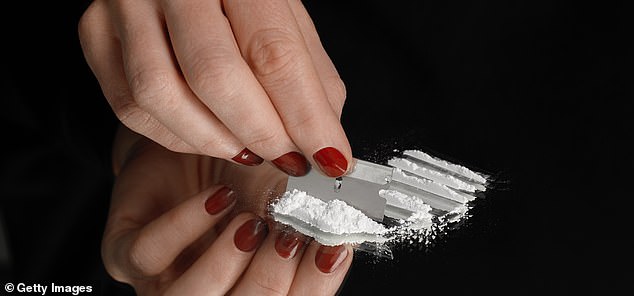
After her son was born, Sarah’s friend offered her a line of cocaine. Soon, she was taking the drug every day after nursery drop off
I saw it as a one-off treat, but soon I was back to my old ways. Looking back I’m horrified that I was in sole charge of this little boy, but snorting lines of cocaine every day after nursery drop off.
While people may imagine addicts as stereotypical ‘down-and-outs’, I’m testament to the fact there are plenty of people struggling with cocaine abuse who hold good jobs, have nice homes, children and a middle-class circle of friends.
I didn’t fully recover until my son was two-and-a-half. I’d started to feel disgusting every time I got high, and knew I had to change for both of our sakes.
I’ve now been sober for over four years, and work as a recovery coach, as well as running my own business.
So what are the secret clues your friend, husband or colleague has a problem with cocaine? Here are the subtle signs I spent years trying to cover up…
They isolate themselves
Drug addicts aren’t stupid – we know what we’re doing is wrong, and so we want to hide it from those who love us.
I used to avoid being alone in a room with people who knew me well, who would notice that I seemed strange. I just wanted to be alone with my drugs – or with other addicts who wouldn’t ask questions.
Friends could never rely on me to turn up to anything; I’d cancel or forget, either too wired to be socially capable or desperate for my next high. I even flaked on my mum’s 60th birthday dinner – there was no excuse, I just turned my phone off and didn’t show up.
If you notice someone who used to be a permanent fixture in your social life shying away from you – perhaps thanks to a litany of ‘doctors’ appointments’ or ‘sick parents’ – it might be worth asking questions.
Constant chatter – or a stutter
If you do end up seeing your friend, you may notice they seem different.
Are they stuttering and stumbling over their words? Or will they just [itals] not [itals] stop talking?
Cocaine can make some people struggle with speech, while others will talk ten-to-the-dozen for hours, without noticing they’re acting oddly.
They’re always tired
Cocaine gives you an intense feeling of awakeness. Plus, many of us binge at night, so sleep is a long way down the priorities list.
Your friend might seem tired a lot, or irritable for no reason. I always remember the jumpiness, the feeling of being wired thanks to countless sleepless nights. The tiredness also makes you forgetful, so you might notice constant small lapses in memory.
When the drug is exiting your system – what users call a ‘comedown’ – you can feel angry, as if everyone is out to get you. It’s a unique and awful sensation. Consider this if your friend seems to take offense at everything you say, however innocent.
A good job… but pleading poverty
Cocaine users have to find ways to explain why they’ve got no money, too. It never quite tallied that I had a good job but couldn’t afford a pair of £6 Primark pyjamas for my son. Look out for your friend with seemingly normal spending habits who pleads poverty a little too often.
Constant ‘hayfever’ or ‘colds’
I had to make constant excuses for my permanently runny nose. In the summer I had ‘hayfever’, in the winter I was always suffering from a ‘cold’.
In fact, the most surefire signs of cocaine addiction are physical. The act of constantly inhaling the drug gives you a red nose, makes you sneeze and persistently sniffly.
Your friend might also have lost a lot of weight suddenly and have a drained, gaunt face, with a dead quality to their eyes.
I always had angry red skin on my face, too, because when I was high and fidgety I’d pick the skin on my cheeks till it bled.
What about alcohol?
You might read all of these signs and think they could equally apply to an alcoholic.
But cocaine has some unique effects. I’ve never felt the same level of irritability and anger on a hangover as I have on a comedown.
Plus, alcoholism is more ‘acceptable’ – not to mention drinking is legal. Cocaine can also make you react differently to alcohol in itself, masking the effects of drunkenness, allowing you to drink for longer. Though I could take or leave alcohol when sober, when using I’d polish off 15 bottles of Corona in one sitting.
So if your friend seems to be drinking a huge amount without the corresponding effects, they might be using too.
*As told to Olivia Dean