About a quarter of a century ago, when I was researching a profile of the Bank of England, I was invited to tour its vast vaults.
Located beneath the bank’s Threadneedle Street headquarters, the labyrinth of eight pillared chambers occupies an area the size of ten football pitches.
In these it held – for a fee – the gold reserves of more than 30 countries, including many of the newly minted nations that emerged from the old Soviet Union and a number of Middle Eastern oil states.
There was even an ingot stamped with a Swastika that had been captured from Germany during the Second World War.
As one of the world’s official depositories, the Bank’s porters would simply move ingots from one glistening heap to another as central banks bought, sold or exchanged gold on international markets.
But what struck me most powerfully was the relatively diminutive size of the UK’s cache. This was largely thanks to the decision of the Labour Chancellor of the time, Gordon Brown, to diversify our reserve portfolio by selling half our gold – 395 tons of it – between 1999 and 2002 at an average price of $275 an ounce.
Quite how wrongheaded this move turned out to be has never been made more obvious than this week, when the gold price surged past $4,000 an ounce.
If all that bullion had remained securely in the Bank of England’s hands, it would now be worth £35billion more than what we hold today, and Britain’s public finances would look a great deal less precarious.
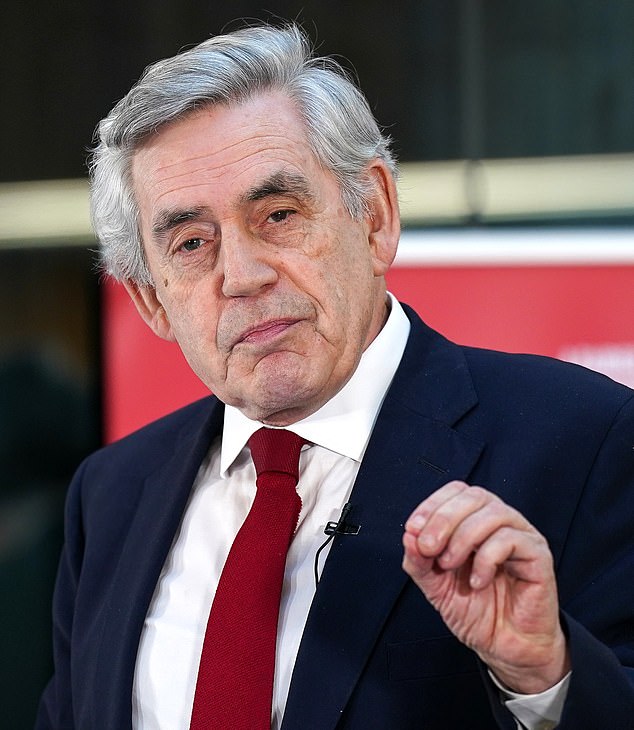
Gordon Brown sold half of Britain’s gold – 395 tons of it – between 1999 and 2002 at an average price of $275 an ounce
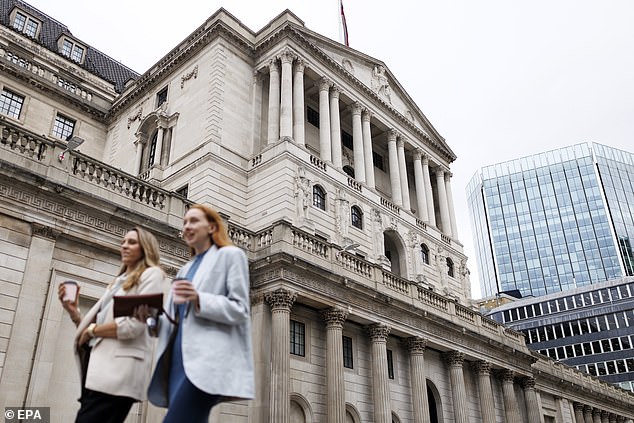
If all that bullion had remained securely in the Bank of England’s hands, it would now be worth £35billion more than what we hold today, and Britain’s public finances would look a great deal less precarious
And gold has never been more in demand, with banks among the biggest buyers of the stuff.
As financial institutions the world over take fright at the increasingly alarming levels of debt being built up by nations that once had a reputation for being among the most stable economies in the world, they are investing more and more of their funds in an asset that is renowned for being a safe haven in times of trouble.
And bonds issued by national governments to fund their borrowing are not the only financial instruments that fund managers, central banks and personal investors are losing trust in.
With the air thick with talk of a stock market crash, equities are out of favour too, particularly shares in tech giants heavily invested in the AI sector, which many see as a bubble waiting to burst.
Given that gold is in relatively short supply, it doesn’t take many big spenders to send the price soaring. After all, the US stock market is 200 times bigger than the gold market, so even a small move out of stocks into bullion can trigger a big percentage increase in the gold price. Indeed, all the gold that exists in the world could fit into four Olympic-sized swimming pools.
While bullion is at a record-breaking level – a price so high that gold wedding bands will now be inaccessible to many young couples – I can’t see it going down any time soon.
Yes, it’s up a sizzling 53 per cent this year after jumping 24 per cent in 2024, and, yes, there might be some short-term profit-taking in the coming days, but we live in such unstable and volatile of times that, when it comes to gold, the mantra still has to be: Buy, buy, buy.
It may not offer the currently generous interest rate returns offered by bonds issued by most of the Group of Seven richest countries. And it may also lack the strange allure that has recently driven Bitcoin and other cryptocurrencies to dizzying heights.
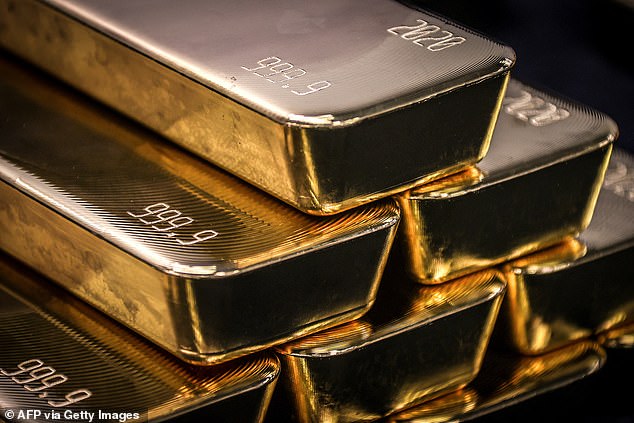
Gold prices have surged past $4,000 an ounce – up 53 per cent this year alone
But with G7 economies such as the US and France in turmoil and others, like the UK and Japan, battling with black holes in their public finances, there is a growing lack of faith in paper money and bonds.
The US government, for example has to all intents and purposes been shut down because of a bitter dispute between Congress and the White House over soaring American debt levels, with a resulting loss of confidence in dollar assets.
Meanwhile, France is in chaos following the resignation of its fourth prime minister in just over a year, with many predicting a snap parliamentary election, a move which could well make matters worse at a time when the economy is already in crisis due to soaring borrowing and debt levels.
So worried is the International Monetary Fund about global debt levels that last week it published a blog entitled ‘Uncertainty about uncertainty’. And if there’s one thing the global financial markets hate, it’s uncertainty.
In recent years, investors have piled into share markets on both sides of the Atlantic believing that fast-growing AI start-ups, coupled with the Silicon Valley giants – in particular ‘the magnificent seven’ tech stocks of Apple, Microsoft, Amazon, Alphabet (Google), Meta (Facebook), Nvidia, and Tesla – can solve the world’s problems.
But top-of-the-market transactions such as Nvidia’s $100billion (£75billion) investment in OpenAI and Microsoft’s similarly monumental bets on AI have put the wind up many stock market investors.
Such moves have only helped to fuel the desire for gold as a hedge against a future crash. The herd instinct among central banks and investment managers has made bullion investment, available to ordinary investors through instruments such as exchange traded funds, hugely attractive.
There is something reassuringly tangible about gold as an investment. No one has a clue what they are getting into when they buy crypto products built on computing power. But when gold purchases are made, buyers know there is physical metal stored deep beneath the ground at the Bank of England, or at Fort Knox in the United States, or simply in the safe keeping of jewellers across the globe.
The secrecy that surrounds the bullion markets makes it impossible to know exactly who has been driving the gold price to its current level.
But cooling relations between the US and its biggest economic rival China mean that Beijing has become an enthusiastic buyer. Until recently, the Chinese were happy to hold American dollar assets – Treasury bills, bonds and the like – in their vast store of reserves estimated to total $3trillion thanks to the vast trade surpluses they generated by selling goods to the West.
But after Russia’s invasion of Ukraine, when Western countries froze Moscow’s reserves held in Western central and commercial banks, China became nervous and switched its attention to the bullion market where it has been among the major buyers.
Russia, which is still accumulating surpluses by selling oil and natural gas to India and China, has also been coveting gold.
Meanwhile, India – with its increasingly populous and wealthy middle class – has long been a gold enthusiast.
But as the gold price goes through the roof, the UK – thanks to Gordon Brown’s colossal misjudgment – has negligible gold reserves.
Aficionados of the precious metal, known as ‘gold bugs’, have never lost their faith in bullion and their belief has finally been repaid with vast gains on their investment.
But while they have been proved right, the strength of gold is a signal that the world has become unsafe for investors. Central banks, hedge funds and ordinary punters alike would be wise to gird their loins in preparation for an oncoming financial catastrophe.