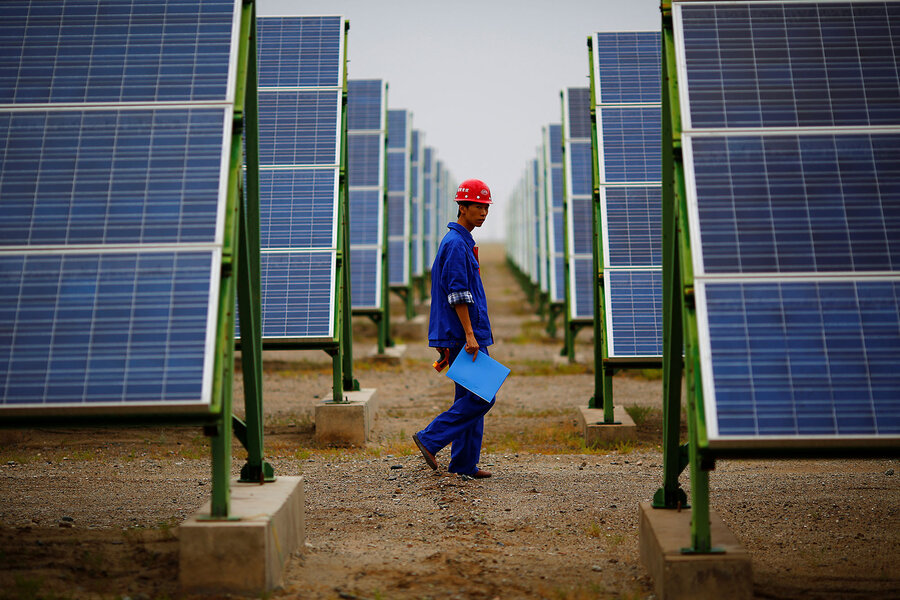
China is now the dominant force both causing and restraining global warming. Over the past decade, China has been responsible for 90% of the growth in the carbon dioxide emissions that are raising world temperatures, research shows. Yet China is also at the forefront of the world’s green energy transition, and is filling a leadership void left by the United States as Washington has withdrawn from international climate agreements.
For this reason, all eyes were on Beijing’s new climate pledge unveiled at the United Nations last month.
On one hand, the pledge marks a step forward. For the first time, China has set an absolute target for cutting emissions, rather than limiting future growth. In another first, its pledge covers all greenhouse gas emissions and economic sectors.
Why We Wrote This
China’s new climate pledge marks a modest step forward for one of the most populous countries in the world. They also reveal how the bar for climate leadership is dropping lower.
Nevertheless, experts say China’s commitment falls far short of the robust targets needed to fulfill the Paris Agreement imperative to limit the rise in global temperatures to less than 1.5 degrees Celsius.
What are China’s new goals?
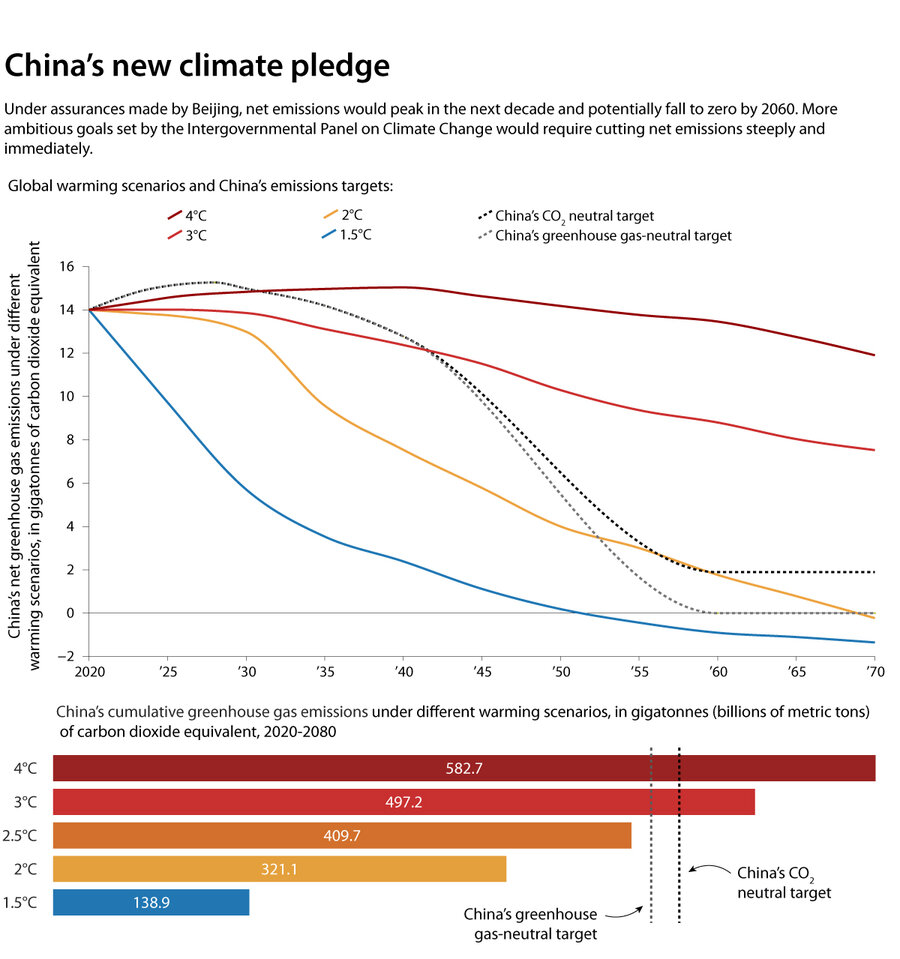
In a video address to the United Nations climate summit in New York on Sept. 24, Chinese leader Xi Jinping said his country would cut greenhouse gas emissions across its economy by 7% to 10% from the peak level by 2035. China’s reduction should be closer to 30%, experts say, to be on track to meet Paris Agreement goals.

“The level of ambition … is quite low,” considering China’s responsibilities under the Paris accord, and is “especially low, compared to what they can deliver, given the astonishing clean energy boom happening in the country,” says Lauri Myllyvirta, a senior fellow at the Asia Society Policy Institute’s China Climate Hub.
Moreover, by linking the cuts to an as yet undefined “peak” rather than a specific year, Beijing “risks creating an incentive for emissions increases” by localities and firms that seek to lock in fossil fuel capacity at a higher base, says Mr. Myllyvirta.
Mr. Xi also pledged that, by 2035, China will boost the share of nonfossil fuels in total domestic energy consumption to more than 30%, and will increase the installed capacity of wind and solar power to 3.6 billion kilowatts, or more than six times the 2020 amount. Both targets are conservative, experts say.
Asia Society Policy Institute’s China Climate Hub
|
Jacob Turcotte/Staff
Can China meet these targets?
China’s track record tells us it has the ability and willingness to meet these goals. In fact, it has the capacity to make even bolder emissions cuts, but leaders are proceeding with caution.
“The pledge is a bit modest,” says Yanzhong Huang, a professor at Seton Hall University’s School of Diplomacy and International Relations. “They seem to frame it as a floor rather than as a ceiling. … They certainly don’t want to overpromise.”
China’s rapid progress in expanding solar, wind, and other renewable sources of energy in recent years is the most important indicator that the country could cut emissions at a faster pace. For instance, China in 2020 vowed to more than double its renewable energy capacity to 1,200 gigawatts by 2030, but ended up reaching the goal more than five years early.
“Wind and solar installation hit record highs,” Dr. Huang says. “In green technology, they have evolved from copycat to innovator. They are essentially dominating 80% of global solar cells. The progress has indeed been remarkable.”
Given these modest goals, can China lead the climate effort?
In the past, U.S.-China competition has been a significant motivator for Beijing’s climate commitments. Today, the lack of U.S. pressure makes it easier for China to set a low bar on targets, while still sounding the rallying cry to reduce emissions.
At the U.N., Mr. Xi made an oblique reference to Washington’s withdrawal from the Paris accord, saying “some individual countries are moving against the tide.” In contrast, he called on assembled leaders to “strengthen our resolve,” calling the green transition “the trend of our times.”
When it comes to addressing climate change, “The U.S. is doing a lot more than abdicating. It’s ceding leadership to China,” says Gary Yohe, a professor of economics and environmental studies at Wesleyan University.
Yet whether China can truly emerge as a leader in combating global warming remains to be seen, experts say.
Overall, domestic priorities such as Mr. Xi’s focus on energy security appear to be driving Beijing’s climate pledge decisions.
To hedge its bets, China has built up renewable energy while also scaling up the coal industry and producing more oil and gas – giving the country more energy than it needs.
To experts, Beijing’s climate pledge suggests that, so far, the leadership has not decided to strongly prioritize renewables or fossil fuels. But as the green energy expansion continues, that could change, putting China on track for “a much larger emission reduction by 2035,” says Mr. Myllyvirta.