Standing above the city of Portland, Oregon, federal agents on the roof of an Immigration and Customs Enforcement building scan the crowd below where a few dozen protesters are gathered. The agents are not National Guard members. They’re the forces already tasked with securing the building.
But they are not enough for President Donald Trump. In his latest norm-breaking streak, Mr. Trump has used protests to justify involving the military in his fight against crime, illegal immigration, and what he calls an “invasion from within.”
Demonstrations at the Immigration and Customs Enforcement (ICE) field office in Portland have at times turned violent since June, but Mr. Trump on Sunday falsely claimed, “Portland is burning to the ground.” Officials in the Democratic stronghold say city police have protests under control and blame the federal government for the spike in tension. The president has called the protesters “insurrectionists” and said he would consider invoking the Insurrection Act to bypass court rulings preventing him from sending National Guard troops to the city.
Why We Wrote This
An Immigration and Customs Enforcement office in Portland, Oregon, is an epicenter of protests and the legal battle over President Donald Trump’s deployment of the National Guard. At the building, the Monitor finds both law enforcement and protesters grappling with security issues and free speech rights.
Protecting the federal ICE facility and its personnel is a key reason the administration says it wants to deploy the National Guard in Portland. It’s also a rationale Mr. Trump gave to justify sending Guard troops to Los Angeles in June. Yet a group within the Department of Homeland Security is already tasked with providing such security to federal sites: the Federal Protective Service (FPS).
In an interview at the ICE field office in Portland with Chris Hayes, the assistant director for field operations at FPS, the law enforcement officer offered a more measured assessment of the situation – not alarmist, but saying the safety concerns faced by his agency are real.
“On a daily basis, the officers are being confronted with extremely angry people, and they are trying to maintain the security of this facility,” he says. “We’ve seen assaults on officers. … And at the same time, we’ve had people off on the sidewalk who have voiced their opinion without the violence.”

Sarah Matusek/The Christian Science Monitor
The interview with Mr. Hayes, and access to the building here, provides a window on work that FPS does nationwide to protect federal facilities and workers from potential harm. Mr. Hayes says the FPS staff in Portland will “utilize that support however we can” if Guard troops arrive. At the ICE facility on Sunday in his dark-blue uniform, he said he had no opinion on the temporary restraining order granted the previous evening by federal Judge Karin Immergut. The Trump-appointed judge in Oregon ruled that the administration could not send in Guard troops because “this is a nation of Constitutional law, not martial law.”
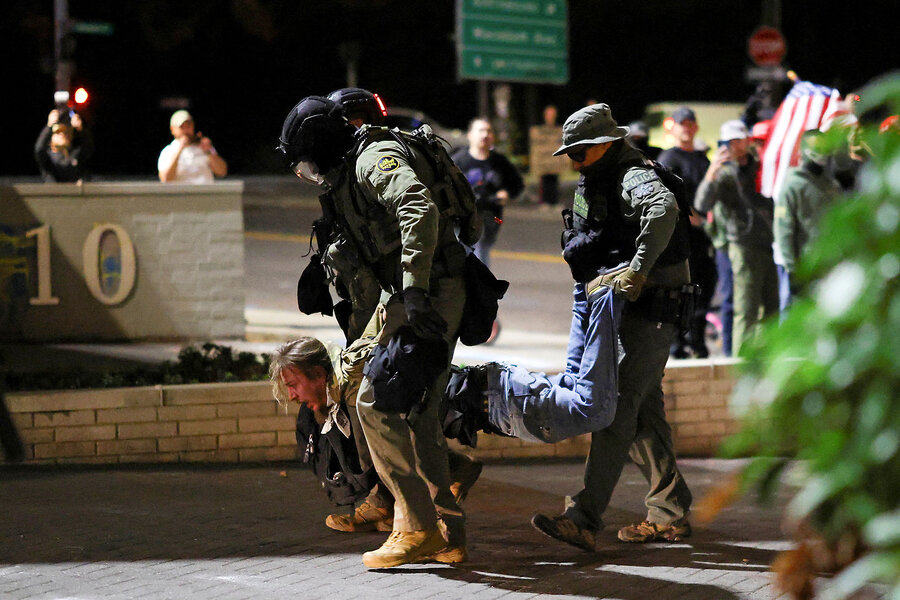
At the ICE facility, the Monitor witnessed sporadic clashes between officers and protesters outside the gate, during which agents appeared to detain two people. Inside the building, a conference room had blackened windows while agents stood guard on the roof. Staff from agencies beyond FPS, including the Federal Bureau of Prisons and Customs and Border Protection, were on-site for crowd control.
Protesters outside on Sunday, meanwhile, donned pajamas and carried signs as they voiced opposition to the Trump administration’s immigration enforcement campaign and possible military intervention. As night fell, the crowd grew more raucous.
Free speech and safety at stake
The ICE field office in South Portland, near the Willamette River, bears evidence of antagonism toward the immigration agency. “MOLOTOVS MELT I.C.E.” is written in graffiti on a concrete edge of the boxy white building. One sign purports to reveal the photo and home address of a local ICE agent. Protesters left a fake guillotine behind.
The agency has been arresting immigrants when they show up to check in at field offices like this. Since June, demonstrations have fluctuated in size, from a handful of protesters to a few hundred, according to court documents and local media reports. Officers have at times fired into the crowd with irritants like pepper-spray balls. The activity appears confined to roughly one city block and is far smaller than this city’s racial justice protests of 2020 that drew thousands.
In an Oct. 2 court filing, the Justice Department claimed protesters have assaulted federal law enforcement with “rocks, bricks, pepper spray and incendiary devices,” have damaged parts of the property, and have impeded the entry and exit of vehicles.

Stephen Lam/San Francisco Chronicle/AP
FPS is “stretched to the point of collapse,” Justice Department lawyers wrote. However, Mr. Hayes says, “I haven’t had any issues with morale” in Portland.
Before Judge Immergut blocked the moves, the Pentagon said it was preparing to deploy 200 Oregon National Guard members – and possibly other states’ National Guard – to protect federal property and personnel.
President Trump said on Truth Social that the request for military assistance came from Secretary of Homeland Security Kristi Noem. The Monitor asked DHS to confirm and clarify why the military, not just additional federal law enforcement, was necessary for the protection of the Portland site.
“President Trump is using his lawful authority to direct the National Guard to protect federal assets and personnel in Portland following months of violent riots where officers have been assaulted and doxxed by left-wing rioters,” Assistant Secretary Tricia McLaughlin said in a statement. She also called protesters “domestic terrorists” who would not be allowed to attack law enforcement.
On Tuesday, Ms. Noem visited the ICE office in Portland and met with Oregon Gov. Tina Kotek and other local officials. She told local media her visit was intended to “secure some partnerships that will keep our officers safe and allow us to enforce federal law.”
The presence of FPS at the ICE field office in Portland predates the protests. FPS personnel screen visitors and manage the entry and exit of vehicles through a gate.
Other federal law enforcement branches augment the more than 20 FPS personnel on-site, according to Mr. Hayes. FPS also collaborated with a range of agencies during the 2020 crackdown on protests in Portland.
FPS reports securing over 8,500 federal properties nationwide. The agency has not been affected by the government shutdown. It’s funded by fees for its services and receives no direct appropriation from Congress.
Mr. Hayes says there is some communication between FPS and the Portland Police Bureau. The police department reports making 36 arrests in the area “since the nightly protests began” four months ago. Federal authorities manage the ICE building and driveway, while police are responsible for the surrounding streets, says police spokesperson Terri Wallo Strauss in an email.

Stephen Lam/San Francisco Chronicle/AP
Local and federal finger-pointing have ratcheted up over the past week. A Justice Department official on Oct. 3 announced an investigation into the police department over its handling of the arrest of Nick Sortor and the alleged assault by protesters of Katie Daviscourt, both of right-wing media, who have been filming the protests and verbally sparring with participants. The county district attorney’s office dropped a disorderly conduct charge against Mr. Sortor on Monday.
The same day, the city of Portland responded in a letter to the Justice Department that the federal government appeared to engage in viewpoint discrimination by “providing special access to the ICE facility for social media ‘influencers’ who favor the federal administration, while targeting with force those who use social media to document the conduct of the federal government.”
The city also asserted the federal government is appearing to employ “unconstitutional uses of force” outside the facility. Social media footage from earlier this month appears to show an FPS officer, on the street, spraying a protester in the face at close range. The FPS officer has been relieved of his law enforcement authority pending investigation of the incident, according to a spokesperson for the agency.
An eclectic crowd
Tensions seem mostly to tip into chaos at night. During daylight on Sunday, a largely peaceful crowd of a few dozen people turned out.
A person who gave his name as Shadow says he’s protested here for months “to denounce what ICE is doing – separating families.” He carries a pride flag, along with a well-worn, red first-aid kit to attend to fellow protesters.
“My perk’s out here, knowing I’m helping people,” he says. “I don’t get paid. Everybody thinks that we as agitators get paid.”
Many oppose military intervention. The South Waterfront area was calmer before the announcement of possible troops, says Angie Scripter, who lives in the neighborhood. Now there are more people, along with “helicopters every night, hovering.”

Sarah Matusek/The Christian Science Monitor
Vincent Hawkins, an emergency-room nurse who’s protested for months, says he was moved by a mother who was reluctant to bring her child to medical care due to fear of immigration authorities. He supports “following the rule of law,” and opposes the government’s immigration enforcement tactics, including courthouse arrests.
Mr. Hawkins says he’s less concerned than others about a potential troop deployment, as a former member of the California National Guard himself. He was activated in Los Angeles in 1992 during protests over the police beating of Rodney King. National Guard troops are “members of their community in a way that an active-duty combat person wouldn’t be,” he says.
Mr. Hawkins sees violence from federal agents as a greater concern. He almost lost an eye from a projectile while protesting in June. Undeterred, he keeps returning with his megaphone.
“I’m not an antifa domestic terrorist. I’m a homeowner, I’m a dad, and I’m a nurse, and I’m somebody that cares about my community,” Mr. Hawkins says, an American flag draped around his neck.
Inside the building, Mr. Hayes of FPS considers the First Amendment expression of many of the protesters below on the street.
“We need to be able to talk, and have communication, and not just be yelling at each other’s face,” he says.