While the international community, Trump administration, and swaths of Israeli society have welcomed the proposed peace deal announced by U.S. President Donald Trump last week and agreed to in part by Hamas, Palestinians in Gaza and the West Bank remain deeply skeptical.
Negotiations on the details progressed Tuesday in Cairo between Hamas, Israel, and the United States. But a lack of trust in both Israel and the U.S. – intensified by a two-year war that some experts say has become a genocide – has left Palestinians believing that even should Israel and Hamas strike a deal, the plan will not lead to peace.
Many Palestinians see President Trump’s latest foray into Middle East diplomacy as a superficial bid for the Nobel Prize rather than an actual attempt at securing long-term peace.
Why We Wrote This
In Gaza, which experienced tremendous loss from the war, and in the West Bank, facing settler violence and military restrictions, distrust of Israel and the U.S. runs deep. Even if the Trump plan is approved, many Palestinians say it will not bring peace.
Even among Palestinians who hope the agreement will be a step toward ending the war, many say it comes as too little, and far too late.
“In the past, when people heard about ceasefire talks, they would cheer, ululate, applaud. This time, no one even smiled,” says Tamer Misilih as he attempts to repair his sandal in his makeshift tent in Deir al-Balah. “People are afraid to feel hope.”
“There is no trust left”
The Trump plan calls on Hamas to release all living and dead Israeli hostages, give up power in Gaza, and surrender its arms. In return, Israel would end the war and release Palestinian prisoners, and an international board would govern the enclave on an interim basis.
Many say that has put both Hamas and the Palestinian people in a tough position.
“I’m not biased toward any political party, but when I look at Donald Trump’s plan, I can’t see any benefit for us as Palestinians,” says Safaa Abu Mady, an Arabic tutor, as her children play in a dusty plot outside her tent in Sharrab Camp, the largest displacement camp in Deir al-Balah.
“If we reject it, it will be bad for us. If we accept it, it will also be bad for us. Most of the points in his plan are not for us,” she says.

“Israel doesn’t act transparently. The U.S. doesn’t act transparently. No one does. Even if a deal is signed, I don’t believe Israel will keep its word,” says Mr. Misilih, noting that the Trump plan gives Israel full control of Gaza’s perimeter. “Maybe they won’t invade Gaza again, but they still control everything – the food, the cash, the crossings. … Even when they’re not here, they will control us.”
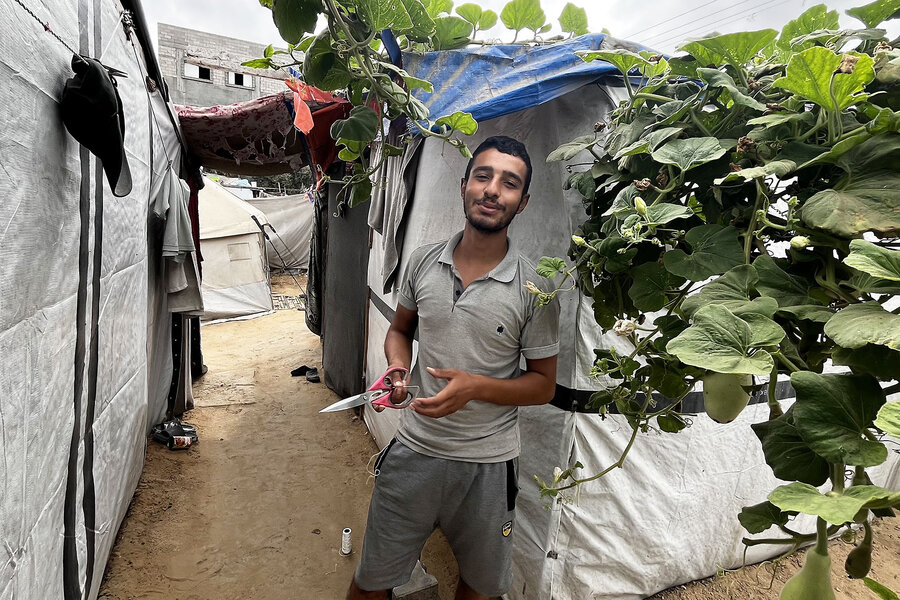
Abu Ahmed Ismail Abu Isaid, a displaced farmer who says Israel killed 35 members of his family, shares Gazans’ disbelief that the war will indeed stop after so many dashed hopes and collapsed deals.
“Since the beginning of this war, we’ve been telling ourselves, ‘Things will be clearer tomorrow.’ But nothing becomes clearer. I can’t believe there will be a ceasefire until I see it with my own eyes,” says Mr. Abu Isaid from his tent on a rented plot of farmland that he now tends. “There is no trust left.”
It is a distrust that extends directly to the U.S. and the Trump administration.
“Most of the weapons used against us are American-made,” says Mr. Abu Isaid. “America strikes us from one side and sympathizes with us on the other. But [in the agreement] we are left out, marginalized, forgotten by all parties. We are the ones paying the price of this war.”
The suddenness with which Mr. Trump pushed for a Gaza deal also gives many pause.
“America has known about the war for two years, and then suddenly, in two days, they wanted it to stop,” says Ms. Abu Mady, the Arabic teacher, whose three siblings have been killed by Israeli strikes. “I know something is wrong, but still, I just want the war to stop.”
Gazans are quick to point out that the mass destruction of infrastructure, the long-term health impacts of famine, and a generational loss of income, homes, land, and education cannot be undone easily.
“We are thrown into the streets without food or water. Our children’s lives and futures are shattered,” says Mr. Abu Isaid, whose 10-acre plot of fruit and olive trees he once relied on has been damaged by the Israeli military. “There are no homes, no streets, no water. Even if we return to our lands, we return to nothing.”
“Chasing after a Nobel Prize”
Palestinian residents of the West Bank, where Israeli military closures, checkpoints, and settler violence continue to choke movement and daily life, also voiced skepticism that the agreement and Hamas’ concessions would lead to peace, or even impact their lives.

“We hope that Trump will move positively, and we hope that the Palestinian people move positively with the agreement, which [Israeli Prime Minister Benjamin] Netanyahu is clearly against,” says Dr. Ali Aljariri, an academic and supervisor of the Hebrew language department at the Ramallah-based Al-Quds Open University.
“Israelis and Palestinians have to learn that war will not bring results to either side,” he says. “Peace will bring development to the entire Middle East – and it will if Trump is serious about pursuing the Nobel Prize.”
“But,” he cautions, “we are living in a time when the might of thugs and bullies rules over the will of everyday people.”
West Bank Palestinians say they do not believe Mr. Trump’s pursuit of a deal is an altruistic push for peace.
“They are just chasing after a Nobel Prize,” says Daoud Zaher, a retiree in Ramallah who, like many, struggles to reach his lands and home outside Ramallah because of settler violence and Israeli military checkpoints and closures.
The plan, he believes, shows “the U.S. and Israel don’t want a Palestinian state. Israel will take the hostages and then destroy Gaza. They push the PA [Palestinian Authority] to the side. They only care about the optics for the Nobel Prize; they don’t care about us Palestinians or our basic rights,” he says. “Even the Arab states are against us,” he says of Arab support for the Trump deal.
“This ‘plan’ is just an ad campaign for Trump to do business deals in the Middle East and sell American weapons, it has nothing to do with peace,” says Bahiya Attiya, a mother of three in Ramallah, who notes that Israeli checkpoints have extended her five-mile drive from Ramallah to her house in a village to a one-hour commute. “Things are getting worse on the ground, and the killing hasn’t stopped. The Nobel Prize committee should stay far, far away from Trump.”

Worrying lack of details
Concerns are mounting, particularly over the lack of details in the plan, such as if, and when, Gaza will be handed over to the PA, which governs the West Bank, or a time frame for Israel to withdraw from Gaza.
“There are fears over this plan because there are no guarantees that the war won’t resume or that Israel won’t intensify its efforts in the West Bank,” explains Kareema, a human resources manager in Ramallah who declined to give her full name.
“This plan gives no guarantees or steps to slow the Israeli attempts to deny us our basic rights or erase us from these lands,” Kareema says.
Dr. Sabri Saidam, a senior official in Fatah, the dominant party in the PA, noted that the authority initially welcomed the plan to stop the bloodshed. Yet the plan’s lack of clarity has left it a mere outline open to interpretation.
Deepening concerns is the foreigner-run board, headed by President Trump and former British Prime Minister Tony Blair, to oversee Gaza’s administration.
The plan “is bringing people outside to run Palestinian life. This is feared by many Palestinians as a resurrection of the colonial past,” Dr. Saidam says. “Palestine is for the Palestinians, and Palestine is to be run by those Palestinians.”