This article is taken from the October 2025 issue of The Critic. To get the full magazine why not subscribe? Get five issues for just £25.
“‘It is the twenty-first century.’ People keep saying that — like it justifies everything, every piece of stupidity.”
That was how David Hare put it in one of the better plays of the late-Blair years.
People didn’t say those words idly. Once upon a time “the twenty-first century” was a byword for an inviolable moral standard in any walk of life, especially politics. It was an invitation to suspend our disbelief, or at least our criticism: a natural thing for a playwright to notice. Certainly, the thought of “going back” was too terrible to contemplate. The last century, its house of horrors widely photographed, had made “the end of history” less a diagnosis of human achievement than a dream of deliverance. The millennium was upon us. In Britain, Tony Blair came armed with what he often called a “vision for a young country”.
The “twenty-first century” was its own defence. To say that X or Y was in tune with the spirit of the times was enough. In Britain, the creators of “New” Labour took a bunch of allegedly incontrovertible social and economic trends and declared that something called globalisation was the central fact of life. The only question remaining was — in the words of Gordon Brown — “whether we manage globalisation well or badly, fairly or unfairly”.
The direction was taken to be unarguable: the emergence of global economies and global societies. The response was also dressed up as a practical necessity: managing the economy would be “depoliticised” as a merely administrative matter; countries would become multicultural; and government would “stretch both below and above the level of the nation state”, as one of the Blairite philosophes put it.
I call this ethos “Millennialism”. And no matter how many supposedly benign words such as“fairness” and “pragmatism” were showered over it, we hardly need a cynic to point out that Millennialism was very much an ideology — and an ideology directed to fervently political ends.
What those ends were is a matter of some debate. The 20th century was full of political philosophies animated by visions of the future, and people had been talking about the necessities of globalisation since the 1970s.
What really matters to us is that Millennialism was the handmaiden of a new kind of populism that was pioneered by New Labour after 1997 and which revolutionised the British political system. We are gradually becoming aware of how far the Blair Revolution went towards overthrowing the constitution. The traditional institutions of political life were marginalised. Parliament had its powers eroded sideways, upwards and downwards by the explosion of quasi-autonomous regulatory bodies, the ever-expanding competences of the European Union, and the fervour for devolution.
This journey towards the model of a “normal” European nation-state was completed by the Human Rights Act and the creation of the Supreme Court, turning the higher judiciary into a law unto itself, responsible for curating a growing body of what was, essentially, judge-made law.
These changes gave the Blair revolution the best chance of continuing piecemeal, whilst protecting its foundations from the prospect of mass repeal. “We inherited a feudal state,” one of Blair’s underlings is supposed to have said in victory in 1997: “We’re going to create a Napoleonic one.”
Napoleon, the most legalistic warlord in world history, is not known for his democratic tendencies. There was a great deal of talk about “empowering civil society” in ways supposed to be more meaningful, a great number of promises about “the widest possible diffusion of power and responsibility”.
But the British state had become considerably more authoritarian. European law was essentially above scrutiny, except by the government itself. The exploding number of quangos were staffed by a vast coterie of New Labour apparatchiks, which — surely with honourable exceptions — behaved like the managerial nomenklatura of a Soviet state, insiders bending their little fiefdoms to service of the project.
Devolution localised power, but only by concentrating it in the hands of small party elites. In at least one case, the result was not only a turn to authoritarianism on a regional scale, but a significant measure of corruption as well.
With institutional democracy in disarray, the bond between rulers and rules came to centre on politicians pontificating about “national values”, usually to prove that the inevitabilities of globalisation were not just inevitable, but right and good. Things Can Only Get Better, after all.
“Modernisation,”Blair said, is “the application of enduring, lasting principles for a new generation” as he and his ministers set themselves to educating the population in what these principles might be. They tended to be hopelessly vague concepts such as “being tolerant” (later also “diverse” and “inclusive”).
The vagueness sat nicely alongside the anti-political cultural vibe that lasted until the Iraq War: a period when Tracy Emin memorably defined Britishness as the sight of “sexy, stylish people laughing” through the window of a red London bus. In consequence, British political life shifted from a set of common practices performed in shared institutions towards a perpetual litmus test of having the right values. Alongside national devolution for Scotland and Wales, this was another driver of identity politics.
Blair’s success in reshaping “British values” is a mixed picture. Cool Britannia had little impact apart from marketing some of the most soulless art and music in Western history to off-beat Parisians and gullible New Yorkers and making some new friends for Peter Mandelson.
The Iraq War put a large dent in the movement as a source of moral leadership, even within the ranks of the New Labour clerics. Yet there certainly were — and are — a great number of true believers, especially in elite occupations, including the media and higher education. But at its heart, Blairite populism always struggled to shake off the idea that the electorate was a consumer with wants to be satisfied — that naïve utilitarianism captured in the expression “what works”. Hence the most enduring tokens of life in the 21st first century were economic: “the end to boom and bust” and “sharing the proceeds of growth”.
❂
Few things are really unprecedented: despite its reputation for intransigence, the British right has a history of succumbing to the fashions of the left. The Tory grandee Richard Law once wrote “the Socialist believes in what he is doing, the Conservative does not … He is like a man caught up in another man’s dream”. That was in 1970.
The question in 2010 was whether the Conservative leadership realised the situation at all. David Cameron’s coalition government did little to challenge the new order, from the “compassionate Conservatism” that foreswore serious public service reform, to the “Big Society” with its fanciful ideas of empowering communities and the temporary “austerity” that unseated permanent economic change.
More remarkable, however, was the fact that the Tories did not simply join the cult: they continued to develop it even after the events of 2016. Talk of “progressive change” took on a life of its own; eventually morphing into a language of tackling “burning injustices” and producing catastrophes such as Net Zero. Devolution was radically extended. Cameron even made a less-than-wholly-successful attempt to entrench Britain’s EU membership.
So little effort was made to rectify the radical politicisation of culture and education that the right entered the “culture wars” of the 2020s virtually defenceless. EDI hiring in the civil service was a Tory innovation; so was most of the totalitarian speech policing. Identity politics had by then taken over high political strategy: I remember a Cabinet minister telling me excitedly that the leadership of “an Indian man, followed by a Nigerian woman, would confound the left”. It didn’t.
The Conservatives might have got away with all this — at least electorally — had they established a reputation as diligent technocrats rather than agents of what was charitably described in the left-wing press as “Italian” levels of chaos.
Predictably enough, multiculturalism turned out to be a synonym for disintegration, firing the country towards ethnic politics. Millennialism spawned increasingly radical variants of itself. The cult of “the way the world is going”, grew more intolerant of dissent. All of this would have been destabilising enough on its own had it not happened to coincide with a period of rapid technological change, mass immigration and the biggest revolution in communications since the printing press.
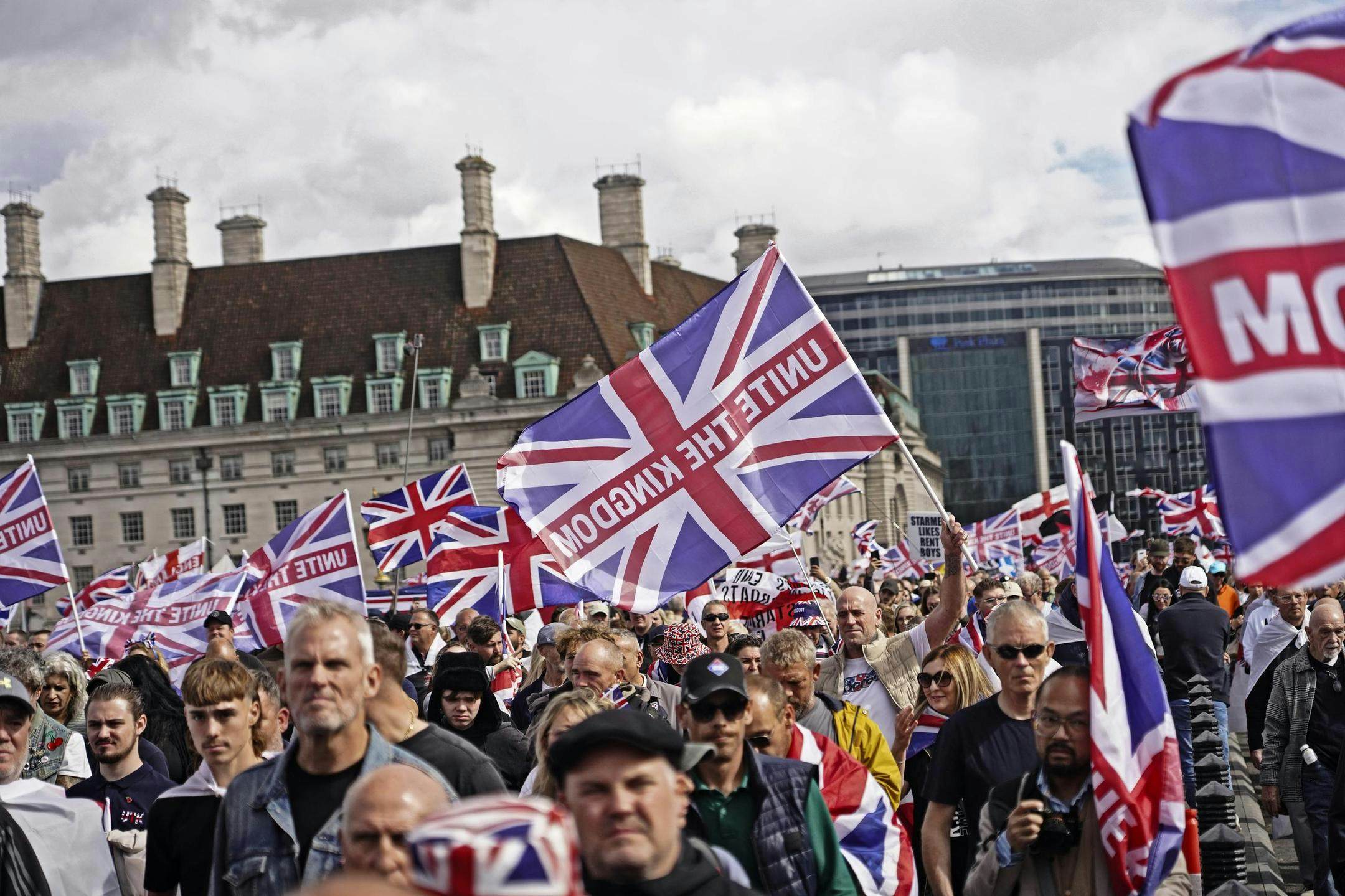
In the midst of all this, there was one moment of bona fide revolution. One of the reasons why Brexit destroyed so many minds was that it upended a series of cosy assumptions about Britain’s future; one of the most telling aspects of the reaction against it was the vilification of “nostalgia”. Whatever else it was, Brexit was a riposte to the tyranny of the zeitgeist.
History loves an irony, however. The referendum was the last act of the Blair constitutional revolution: the collapse of institutional politics entirely, and its replacement with a kind of civil war by headcount. This fomented — like all civil wars — enduring divisions within society. True to type, “the people” were not especially empowered by the process, at least beyond the powers of disruption. Rather, the referendum gave the political class carte blanche to “interpret” the result.
“Taking back control” quickly lost its democratic connotations, supplanted by the promise of a better technocracy, which by 2022 had lapsed back into dumb managerialism and yet more musings on British values.
❂
We have to recognise the enormity of what has been lost. For the last couple of centuries, the British have demonstrated a certain genius for politics. That’s all gone now. We have become what the Blairites thirsted for: a normal European country with few impediments to tribal politics — and we are the worse for it.
The new constitution doesn’t work. The revolution failed. Our economic situation is poor. Relations between the “communities” of Blair’s Britain seem to be just as bad, and worsening more quickly. The conflict of values is making politics more identitarian: parts of the right are returning to Christianity; parts of the left are now openly aligned with radical Islam, or else crypto-theologies of their own devising. For all we like to say that bad ideas are usually French, the British intelligentsia has been a far more pernicious enemy of national unity.
Below the ivory tower, marchers are taking to the streets. It’s hard to gauge the severity of the situation, but it’s worth taking it seriously. There were revolutions in Europe in every other century. Why should this one be any different? It’s hardly as if the times have stopped changing. There was a civil war in part of this country, Northern Ireland, that lasted for much of the last century.
History loves an irony. Our hunt for modernity seems to have brought us back to the world of friends and enemies. How do you govern a country so deeply divided? Better government and civil service reform just introduce another hostage to fortune: the utopian quest for better administration is a large part of what brought us here.
Besides, it’s hard to resist the feeling that everything short of re-founding the state is just a stopgap. Hence the appeal of acceleration: if terminal crisis is the only way out, bring it on.
The problem with this is that founding free countries is the blackest box in political philosophy. We know how republics disintegrate, but our understanding of how you create them is slight. As a manifesto pledge, “instil civic virtue” is as vague as any of the Blairite offerings.
I thought it was an illuminating moment in our culture when the Star Wars sequels gave up on the story of re-founding the republic and just brought the Emperor back from the dead: the archetypal California tech bro, with his hoodie, hokey religion and world-ending tech. Bah Moldbug.
If we are going to find our way back to some kind of stability, I have one observation. It seems to me that an awful lot of those crowing about the evils of “populism” were chiefly responsible for hollowing out the institutions of parliamentary democracy in this country: replacing a Parliament which everyone recognised at the centre of political life with a bunch of less accountable institutions and a lot of lecturing on morality and how to be British.
Many of these institutions are literally irresponsible — not in the sense that their leaders are necessarily reckless people, but because they are either visibly accountable to no elected official or (as is the case with every single devolved entity) they are not substantially responsible for raising the money they spend.
It is no coincidence that the last Conservative leader who could answer the question “what is Conservatism?” without descending into riddles used to say it was basically about parliamentary government.
The centrepiece of Thatcher’s revolution was not economic freedom, but the return of effective power from shady cabals of civil servants and trade union bosses to a Parliament which everybody recognised as legitimate, because it was legitimate, because it answered to them.
Across the West, many countries have spent decades marginalising their legislatures on the spurious grounds that they are too inefficient for the rapid and globalised world.
In making this point, they miss something more fundamental. Democratic legislatures are not instruments of national destiny; they are the means of keeping the public and the political elite at peace with one another.
In an era of rapid change, such institutions are not less, but vastly more important. Once this foundation has been restored, then we can start talking about the challenges of the 21st century.