President Donald Trump’s push to put National Guard troops on the ground in multiple U.S. cities has created a rapidly intensifying situation that’s posing a new test for democracy and the separation of powers.
U.S. District Judge Karin Immergut, a Trump appointee, ruled on Saturday that the Trump administration couldn’t take over Oregon’s National Guard to deploy them on the streets of Portland. When the administration tried to get around that ruling hours later by calling up California National Guard troops instead, Judge Immergut quickly shut that down, saying the move was “in direct contravention” of her earlier decision.
The developments left the president and his team apoplectic.
Why We Wrote This
As President Donald Trump pushes to deploy the National Guard in Democratic cities, a battle is escalating over the use of troops to support a crackdown on illegal immigration – testing the balance of powers between the executive and judicial branches.
White House Deputy Chief of Staff Stephen Miller blasted the first ruling as “legal insurrection” and went even further after the second. “A district court judge has no conceivable authority, whatsoever, to restrict the President and Commander-in-Chief from dispatching members of the U.S. military to defend federal lives and property,” he declared on X, calling the ruling “one of the most egregious and thunderous violations of constitutional order we have ever seen.”
It’s not the only battle that’s taking place in the streets – and courtrooms – of a major American city. Illinois and Chicago filed their own lawsuit on Monday seeking to block the Trump administration from deploying Texas and Illinois National Guard troops in their state, calling the move “patently unlawful.” A federal judge declined to immediately block the deployment, but told the administration to “strongly consider taking a pause” until a hearing scheduled for Thursday.
These court fights, along with the increasingly heated rhetoric, mark the latest escalation in Mr. Trump’s effort to normalize the use of the U.S. military in domestic settings while putting pressure on both the judicial branch and resistant Democratic-led states.
The administration is taking actions previously unseen in American cities by claiming an emergency around unauthorized immigration and public safety, sending in waves of federal agents, and citing the need to protect them from local protesters. The moves have triggered confrontations with the courts.

Gerard Magliocca, a Supreme Court historian and constitutional scholar at Indiana University’s law school, says the current level of conflict between the presidency and judiciary is “unprecedented in peacetime” in U.S. history.
The reason so many of the Trump administration’s moves have been paused by lower-court judges is that many of them have little or no historic or legal precedent, says Professor Magliocca. The judges want to pause those actions as they consider their legal merits, he says.
Further escalation may be around the corner.
President Trump falsely claimed on Sunday that Portland “is burning to the ground,” and that “insurrectionists” – a term he has used repeatedly in recent days – were behind it.
The Insurrection Act of 1807 allows the president to federalize National Guard units and nationally deploy the U.S. military, but only during specific circumstances, including insurrection and armed rebellion. So that term “insurrection” has a specific legal connotation. When asked on Monday if he plans to invoke the Insurrection Act, President Trump said that he’d consider it.
“I’d do it if it were necessary. So far, it hasn’t been necessary. But we have an Insurrection Act for a reason,” he said. “If people were being killed, if courts were holding us up or governors or mayors were holding us up, sure, I’d do that.”
Democrats worry that’s been the plan all along.
“This escalation of violence is targeted and intentional and premeditated. The Trump administration is following a playbook: Cause chaos, create fear and confusion, make it seem like peaceful protesters are a mob by firing gas pellets and tear gas canisters at them,” Illinois Gov. JB Pritzker said Monday at a news conference. “Why? To create the pretext for invoking the Insurrection Act so that he can send military troops to our city.”
Mr. Trump’s allies in the legal community say lower-court judges have repeatedly overstepped their authority in thwarting the president. The temporary restraining orders are just their latest frustration.
“The issue is that judges are issuing snap judgments,” says Josh Blackman, a professor of South Texas College of Law Houston and a senior editor of the Heritage Foundation’s The Heritage Guide to the Constitution.
In the Portland case, “The court just doesn’t trust the Trump administration. The administration said they need this [deployment] because of the protests at the ICE facility in Oregon,” he says. “The protection of federal facilities shouldn’t need the permission of a judge.”

Aziz Huq, a constitutional law professor at the University of Chicago and board member of the Illinois chapter of the American Civil Liberties Union, disagrees. The law “requires good faith” to prove that the conditions are being met to declare an emergency, he says.
“Merely asserting that something is the case when it is plainly not is [not] a meaningful compliance with the law,” he says. Otherwise, “the White House or the government could say ‘anything that we think is rebellion is rebellion.’”
While Mr. Trump has repeatedly faced pushback from lower court judges, the U.S. Supreme Court, which has a 6-3 conservative majority, including three justices he appointed, has so far been more amenable to his approach.
The court has made numerous “shadow docket” orders over the past year that have reversed lower-court decisions. It allowed the Trump administration’s sweeping deportation efforts to continue unimpeded, including permitting racial profiling in ICE stops, and continuing mass deportations to countries other than where immigrants came from.
It has allowed Mr. Trump to fire scores of federal employees, including those in parts of the executive branch previously considered independent agencies, and overturned a nearly century-old precedent limiting presidential power. And it barred lower-court judges from issuing universal injunctions that had previously blocked presidents of both parties from taking actions nationwide until it was determined whether those actions were legal.
The Supreme Court began its new term on Monday, with weighty topics including the Trump administration’s attempts to end birthright citizenship, a legal precedent that has existed in the U.S. for more than a century.
The Portland and Chicago cases may find their way to the court on an emergency basis as well.
“These cases will invariably be appealed to the Supreme Court, and they will rubber-stamp what the president is doing,” predicts Marjorie Cohn, a professor emeritus at Thomas Jefferson School of Law in San Diego and former president of the National Lawyers Guild.
Professor Cohn says that the constitutional order is still in place – but it is growing weaker under pressure from the Trump administration. “The separation of powers still apply, though the line is getting fainter between the three branches,” she warns.
Democratic leaders of the cities and states targeted by the Trump administration are sounding the alarm.
Oregon Gov. Tina Kotek called President Trump’s actions “an effort to occupy and incite cities and states that don’t share his politics.” California Gov. Gavin Newsom warned in a post on X that “America is on the brink of martial law.”
“Donald Trump is using our service members as political props and as pawns in his illegal effort to militarize our nation’s cities,” Governor Pritzker said Monday afternoon as some 300 Guard troops from Texas prepared to fly to Chicago, calling it an “unconstitutional invasion of Illinois by the federal government.”
The Chicago deployment follows weeks of heavy ICE presence and controversial tactics across the city, including a middle-of-the-night raid of an apartment building in which agents reportedly zip-tied and detained dozens of U.S. citizens, including children. Department of Homeland Security Secretary Kristi Noem later promoted that raid with a glossy video tagged with the comment “Chicago, we’re here for you.”
ICE agents have also repeatedly clashed with protesters outside a facility in the Chicago suburb of Broadview, with injuries reported to clergy members, politicians, and reporters. Over the weekend, federal agents said they fired “defensive shots” that injured a woman after they were rammed and boxed in by vehicles, according to DHS. An attorney for the woman who was shot said in court that it was federal agents who had rammed her. On Monday, a coalition of journalists sued ICE and DHS for using excessive force against them.
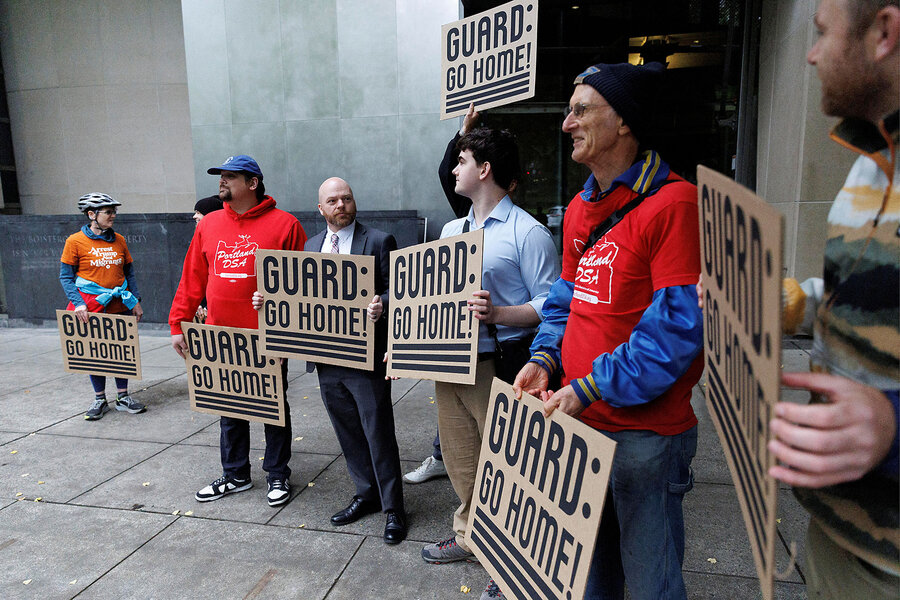
In Portland, recent confrontations between protesters and federal law enforcement appear more verbal than physical. Since June, demonstrations have fluctuated in size outside the ICE field office in Portland, where officers have at times fired onto the crowd with irritants like pepper-spray balls.
In a court filing, the Justice Department claimed protesters have assaulted federal law enforcement with “rocks, bricks, pepper spray and incendiary devices” at the facility, and have impeded the entry and exit of vehicles. The Portland Police Bureau says it has made 36 arrests in the area “since the nightly protests began” four months ago. The activity appears confined, more or less, to one city block.
Staff writers Sarah Matusek in Portland, Oregon, and Simon Montlake in Boston contributed to this report.