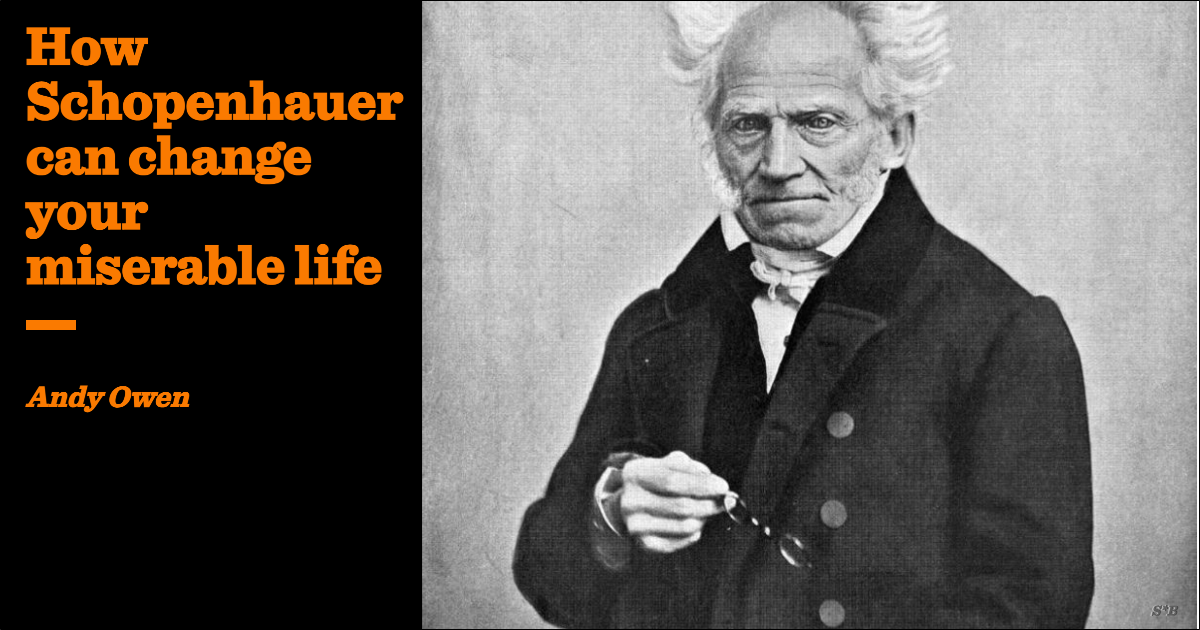
Philosopher David Bather Woods notes that there is a popular style of philosophical biography that presents the philosopher’s life as a model for how to live well. He tells us his new book on Arthur Schopenhauer is not such a biography, not just because of Schopenhauer’s many personal flaws, but also as, for Schopenhauer, for the most part, there can be no question of living a good life. For Schopenhauer, the philosophical pessimist, to live is to suffer and existence is a mistake. But once the mistake is made, live we must (for deeply personal reasons he is not a proponent of suicide), so can the misanthropic sage of Frankfurt, through his philosophy and life provide any consolation?
Through sharing Schopenhauer’s thoughts on life and death, crime and punishment, solitude and society, love and sex, fame, madness, and revolution Bather Woods makes a strong case that he can. Indeed, in our fragmenting world in which we are subject to a constant live-streaming of suffering and social division, increasingly haunted by a feeling that as the old world order comes to an end we’re left on our own to make our way as best we can, he may be the philosopher for our times.
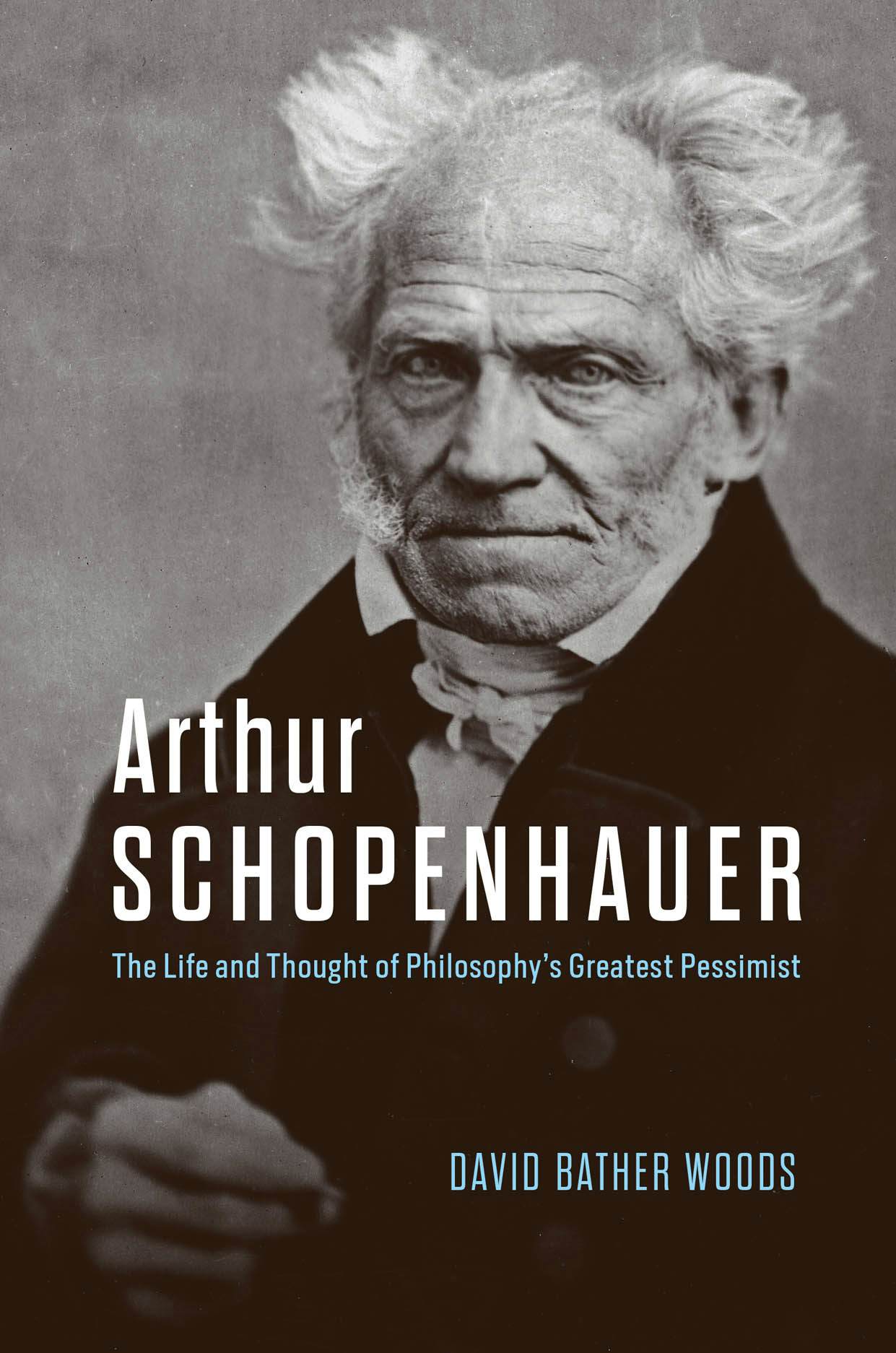
Schopenhauer was born in Danzig (now Gdansk) in 1788 to merchant Heinrich Floris and wife Johanna. He spent his youth in Hamburg, and as a young man travelled extensively across Europe (during which he visited a penal colony in Toulon, witnessed a public execution and spent three months in an English boarding school in Wimbledon). He was meant to follow his father into the family business but after his death, when Schopenhauer was seventeen, he was given more freedom to engage in the arts and sciences. Despite numerous attempts he never established himself within academia. His masterpiece The World as Will and Representation (WWR) was first published in 1819 to an apathetic reception. It was only in his final years, before he died in Frankfurt in 1860, that he achieved the recognition he had always thought he deserved.
That all life was suffering was something Schopenhauer thought was self-evident
Bather Woods explores how the events of his life can be read in the light of his thinking, and vice versa, in particular how his father’s death, by suspected suicide, and his difficult relationship with his mother (she kicked him out of her Weimar home in 1814, communicating only by letter until contact ceased after she discovered a letter where he blamed her for Heinrich’s death) contributed to his unhappiness and conviction that all life was suffering.
That all life was suffering was something Schopenhauer thought was self-evident. A glance at the “loudly crying evidence of a whole world full of misery” disproves Gottfried Leibniz’s optimistic claim that ours is the”best of all possible worlds” (if God could have created a better one, surely he would have). “Optimism” was coined by the Jesuits for philosophers such as Leibniz. “Pessimism” followed describing philosophers like Voltaire, whose novel Candide mocked Leibnizian optimism. “If this is the best of all possible worlds,” Candide asks, “what on earth are the others like?” Schopenhauer, agreeing with Candide, argues, if our world is ordered in any way, it is ordered to maximise pain and suffering.
Schopenhauer sees a brutal and uncaring nature in predatory animals that cannot but devour other animals in order to survive. The world is “a battleground of tormented agonised beings who continue to exist only by each devouring the other…every beast of prey in it is the living grave of thousands of others.”
Civilisation is no better. Our affairs, in what Schopenhauer calls the “many-coloured puppet show”, are characterised by “injustice, extreme unfairness, hardness, and even cruelty.” In WWR, Schopenhauer writes:
If you led the most unrepentant optimist through the hospitals, military wards, and surgical theatres, through the prisons, torture chambers and slave stalls, through battlefields and places of judgment, and then open for him all the dark dwellings of misery that hide from cold curiosity, then he too would surely come to see the nature of this best of all possible worlds.
This is true in peace but more so in war, which is common due to “archfiends” in the form of conquerors, those “who sets several hundred thousands of people, facing one another, and exclaims to them: “To suffer and die is your destiny; now shoot one another with musket and cannon!” and they do so”. In Schopenhauer’s day this included Napoleon. Today there is a new cabal of wannabe conquerors. The life of the individual and that of the nation are both marked by perpetual conflict. He was writing before mankind fought its two most destructive wars, but even then, “History shows us the life of nations and can find nothing to relate except wars and insurrections; the years of peace appear…only as short pauses, as intervals between the acts.”
Schopenhauer built on the work of Immanuel Kant, who argues that all possible experience can only come to us through our faculties; our sensory and mental apparatus. What we experience depends on what there is out there to experience, but also the nature of our faculties. Experience is subject dependent and not objective: we don’t see reality, we see our reality located in a specific place and time. Kant claimed that total reality was divided into two: there are things as there are in the world as themselves, independent of being experienced and which we have no means of direct access, and there are things as they appear to us, as they come to us through experience: the world of appearances.
Schopenhauer’s metaphysics was heavily influenced by Indian philosophy and disputed the central position Christian theology and then Enlightenment philosophy (which was merely a secular version of the same ideas) gave to distinct human souls. Kant left room for the individual soul, believing there were a multitude of things in themselves. Instead, Schopenhauer believed that the life-force that drives us, his “will-to-life”, is contained within all living creatures, making all humans and animals embodiments of the same, universal, will. For Schopenhauer, this is the underlying, inaccessible reality, the universal substratum existing outside space and time, from which every individual arises into the world of appearances, only to sink again after a brief futile struggle for existence.
From his metaphysics, decades before Sigmund Freud, Schopenhauer explains that much of our suffering is caused by unconscious internal processes. We are not rational beings. Intellect is the slave of the will, helplessly commenting on processes that it cannot control. All “willing” springs from need, and thus from lack, and thus from suffering. He claims that “Fulfilment brings this to an end; but for every wish that is fulfilled, at least ten are left denied: moreover, desire lasts a long time and demands go on forever; fulfilment is brief and sparsely meted out.” It also results in boredom. Fulfillment itself is “illusory: the fulfilled wish quickly gives way to a new one.”
Pain announces itself whether we like it or not. We have to actively notice what makes us happy
When we do focus on the present, we tend not to notice what’s going well, instead focusing on the bad. As Schopenhauer states: “we do not feel the health of our entire body but only the small place where the shoe pinches.” Resolving the pinch, we quickly move on to the next problem: “it is like a bite of food we have enjoyed, which stops existing for our feeling the moment it is swallowed.” We rarely feel the benefit of the things we have while we have them. Schopenhauer argues that we don’t appreciate the “three greatest goods,” namely, “health, youth and freedom” until we have lost them. Pain announces itself whether we like it or not. We have to actively notice what makes us happy. Schopenhauer encourages us to appreciate the benefit of having things by recalling what it was like not to have them, and, going further, reflecting on the suffering that was possible for us but hasn’t yet happened.
Regardless if we accept Schopenhauer’s metaphysics, as our society has moved from one based on Christian values, to one of shared Enlightenment values, to one measured on financial value and personal celebrity (based on fame itself rather than any other underlying value), we have installed in our citizens, both the materialist will to consume and the will to be seen, neither of which can ever be sated. Life passes us by as we stare at screens or day-dream about tomorrow, instead of noticing potential sources of joy in the present.
Schopenhauer believed we could achieve temporary peace through aesthetic contemplation, but not the mindless distraction of technology. Art should transport us out of our state of striving to a state of contemplation, allowing us temporary respite and a glimpse of the eternal that we can never really know. Music is the artform that gets us closest to seeing the will-to-life, but true respite only comes with a total resignation. When one accepts the blind, indifferent, purposeless nature of the will-to-life, we become released from our main existential concern: our fear of death. Death becomes a return to the nothingness before birth: “Those will be least afraid of becoming nothing in death who have recognised that they are already nothing now”. This retreat to nothingness, is likely too much for most. Indeed, Roger Scruton claimed, “He [Schopenhauer] enjoyed his pessimistic conclusions too much to convince the reader that he really believed them.” Schopenhauer enjoyed good food, music, sexual affairs and concerned himself with the politics of his day.
Politically he was a reactionary liberal, looking to the state only to protect life and property. To do so, the state could take harsh action (he offered his opera glasses as a telescopic rifle sight to guardsmen firing on a crowd during the popular demonstrations of 1848). Out of caution, he slept with loaded pistols by his bed and refused to allow his barber to shave his neck. Bather Woods observes that he sided with Thomas Hobbes in his recognition that a strong leviathan is needed to deliver security.
Schopenhauer disagreed with Hobbes that human affairs are exclusively born of self-interest. In times of great turmoil noble selflessness stands out (something Hobbes fleetingly recognised in his concept of the Privilege of Absurdity, which recognised that humans are unique in our readiness to kill and be killed for nonsensical ideas in an attempt to give our lives meaning). Despite the universalism of the will-to-life, Schopenhauer did not accept that there was a universal moral character, arguing there are humans in whom “the sight of another immediately excites a hostile feeling, such that their innermost being cries out: ‘Not I!’ — And there are others whose innermost being says: ‘I once again!’ In between there lie innumerable degrees.” He concluded, though, that even if only partly right, it is prudent to err on the side of Hobbes. If everyone were kindly disposed toward each other we could place our trust in the rest of society, but as some are and some aren’t, its best to ensure security is secured by a strong state. This included security against those who justified suffering for the greater good and the promise of some earthly utopia. While his social and political views were in many respects sexist (which Bather Woods contextualises, but rightly acknowledges) and highly conservative, Schopenhauer’s cosmopolitan appreciation of other cultures, dislike of nationalism, and scepticism over the idea of progress led him to be critical of European violence towards African and Asian peoples justified by the spread of Enlightenment values.
Once security was achieved, however, how we should interact within society should be based on compassion — the motive to act on the suffering of others as though it were our own — which is the basis of all morality. As we are all connected as through the universal will this was extended to all humankind, we are all “fellow sufferers.” This also includes animals (he was a supporter of animal rights). His principle of compassion is captured in the maxim: “Harm no one; and help others to the extent that you can.” It combines the passive act of letting others be, and the active act of lending them assistance. This will not inch the world irreversibly towards a better place, but for a time, might alleviate some suffering.
When optimists, in the face of unyielding suffering, insist that life is good and only going to get better — or claim we are in control of our own happiness and therefore if we are unhappy it is our own fault — it makes it worse and adds to suffering the responsibility for that suffering. Schopenhauer believed optimists present humanity’s happiness as life’s aim and object. Starting from this, “everyone then believes that they have the most legitimate claim to happiness and enjoyment” but if they, as they will, fall short, “they believe they suffer an injustice.” Schopenhauer’s pessimism asks us to accept there may be challenges ahead that have the potential to lead to more suffering, but doesn’t insist that things are necessarily going to get worse. Instead, he rejects the idea that things are always getting better and are somehow destined to do so. He was not opposed to the material benefits of science, but the idea that there was moral or ethical progress, leading to a future fundamentally different from the past, as, for better or worse, we are what we have always been.
His insights into our condition show us a way we can carry on and make the best of it
As the writer Rita Felski states: “[T]he weight of what has gone before bears down ineluctably on what is yet to come.” Our pasts shape the eternal present. We are all shaped by our own pasts, our childhoods, our parents’ experiences, and collective group experiences. With this book, Bather Woods does an excellent job of showing how Scopenhauer and his philosophy was shaped by his past. As Bather Woods warned, ultimately, there remains something unresolved in Schopenhauer’s philosophy that prevents easy solutionism. Writing elsewhere, Bather Woods suggests that if we follow Schopenhauer, a semi-satisfied life is the best we can hope for. This would be an oscillation between wish and fulfilment, with enough success in fulfilling our desires that we don’t suffer too much and enough failure to ensure that we are never too bored. It would recognise that we will always be unfulfilled whatever we achieve. It would require an ongoing attempt to lift our eyes from future desires, and instead focus on the present and the shoe that isn’t pinching. Lastly, it would be a life based on compassion to our fellow sufferers.
Schopenhauer offers no easy remedies to a disease with no final cure, for the living at least, but Bather Woods successfully shows us if your eyes can adjust to his dark vision of the world, there is much to see: his insights into our condition show us a way we can carry on and make the best of it.