As Belfast crumbles, the council is splurging £2 million on promoting the Irish language
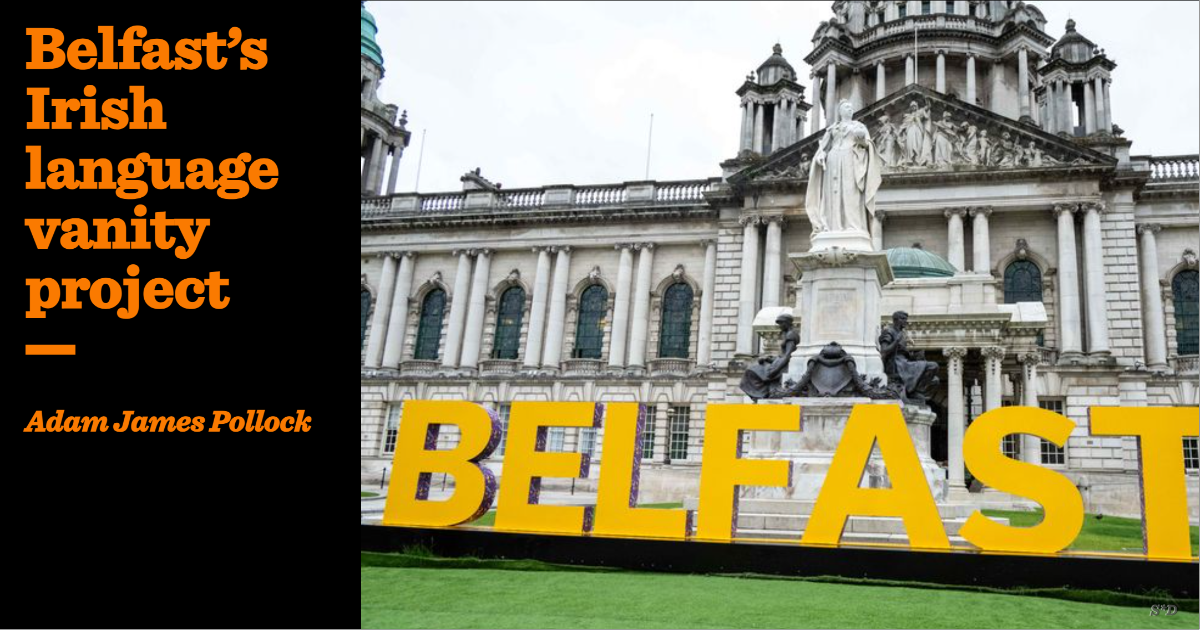
This week, Belfast City Council voted in favour of adopting a new Irish language policy, which, when (or if) implemented, would see the Irish language be used in a more prevalent way in public spaces throughout the city.
The policy outlines how the Irish language should be used in all functions and services that Belfast City Council provide, including, according to them, in “interpreting and translation, key documents and publications, signage at facilities, on the council website”, and necessitating a complete redesign of the Council’s “corporate identity, including its logo”. Nothing says cutting-edge cultural policy like a new corporate identity.
The budget for the initial implementation of this new policy will come to just under £2 million. As one former Ulster Unionist Party candidate for East Belfast put it, you would be forgiven for thinking that the streets of Belfast were paved with gold.
In truth, the economic state of Belfast city, and the country as a whole, is dire. In the city centre, historic buildings are commonly left to crumble into ruin and disrepair, with large footprints of the city designated as heritage at risk; so much for our culture. The homeless crisis in the city is the worst it has been in recent memory, with the number of men sleeping rough in the city increasing by 260 per cent in the past five years. For women, the increase is a shocking 380 per cent. Subsequently, anti-social behaviour including open alcohol consumption and drug use is prolific on the city centre’s busiest streets.
Politicians in Belfast have a habit of implementing policies in direct conflict with the interests of the population
Culturally, the country is suffering. In the financial year of 1999/2000, funding for the Arts Council of Northern Ireland, through which many cultural projects, largely in Belfast, receive funding, rested at £7.5 million, approximately £14 million today. A quarter of a century later, the yearly amount received by the Arts Council for their projects is only £9.5 million. This represents a real term funding cut of 30 per cent for cultural projects.
Belfast is running out of money. It should be viewed as shocking, then, that the City Council have decided to spend almost £2 million on a policy that half of the country would be inclined to view as divisive and entirely unrepresentative of them. In a rare moment of unity for unionism, the three main unionist political parties — the Democratic Unionist Party, Ulster Unionist Party, and Traditional Unionist Voice — all voted against the proposed legislation.
These parties have made clear their concerns about the cost. The Deputy Leader of the Traditional Unionist Voice, Ron McDowell, stated that, after the initial £1.9 million that has been set aside for the policy’s implementation, there have been no costings done at all. “The only place after that that Belfast City Council can have a pool of money is from ratepayers’ pockets,” he said. Dean McCullough, a member of the Council for the Democratic Unionist Party, highlighted how ridiculous it was that residents were, in effect, being asked to foot the bill for a policy they did not want, especially when they could not “get proper access to basic services”.
So why has the City Council voted in favour of such a ridiculous policy? Like the Gaelic Revival of the late-nineteenth century, the recent focus on Irish-specific cultural policies has political aims at their heart. This current iteration is little more than an attempt at clawing back votes and support from those members of the population who increasingly feel that the traditional parties who aim to represent those who view themselves as Irish, rather than British, are actually not doing anything of the sort.
For those in Northern Ireland who are Catholic — and I mean actual, practicing Catholics — there are few parties that one could vote for. All of the main Irish nationalist parties, such as Sinn Fein and the SDLP, are proponents of abortion, same-sex marriage, transgenderism, and the whole litany of progressive politics which were in vogue until quite recently. The religious section of the population find it increasingly difficult to square their support of the Irish nationalist cause with support for parties who continuously legislate in progressive ways on social policies.
Just recently, Belfast City Council elected to commission a new stained glass window under the auspices of then-Lord Mayor of Belfast Micky Murray. The window, which replaced a window that was neither damaged nor unwanted, focused on LGBT pride, and included an image of a man wearing a shirt that said “save sodomy from Ulster”. After submitting a freedom of information request, I discovered that this controversial new window cost £35,000. Nobody asked for this, and the Lord Mayor’s term ended shortly thereafter.
I am — it may surprise you to read — not opposed to seeing the Irish language in the public sphere. I spent several years working in the language sector in Northern Ireland, and attended Irish language poetry and music events (not Kneecap, in case you were wondering). It is positive that there has been a refocusing of thought and attention in recent years to parts of Ireland’s culture which were at threat of disappearing, least of all the literature and music that came with them.
What I am opposed to, however, is a shocking waste of money in a city where every worthwhile project appears to go underfunded. Last year, the council refused to pedestrianise a cobbled street in the bustling Cathedral Quarter of the city, packed with pubs and pedestrians alike, on which cars would crawl late at night and put people in harm’s way. The infrastructure minister at the time, Sinn Fein’s John O’Dowd, cited “underfunding and austerity by the British government” as the reason why the project could not go ahead. It later emerged that the pedestrianisation would only cost £5,000.
Many politicians in Belfast and beyond have a habit of implementing policies, or refusing to do so, in direct conflict with the best interests of the population, instead employing their own pound-shop Machiavellianism in attempts to shape cities as they see fit. Contrary to much of these politicians’ thinking, it benefits an elected representative to act in the interests of the electorate. If winning votes is the aim, they may want to bear this in mind.