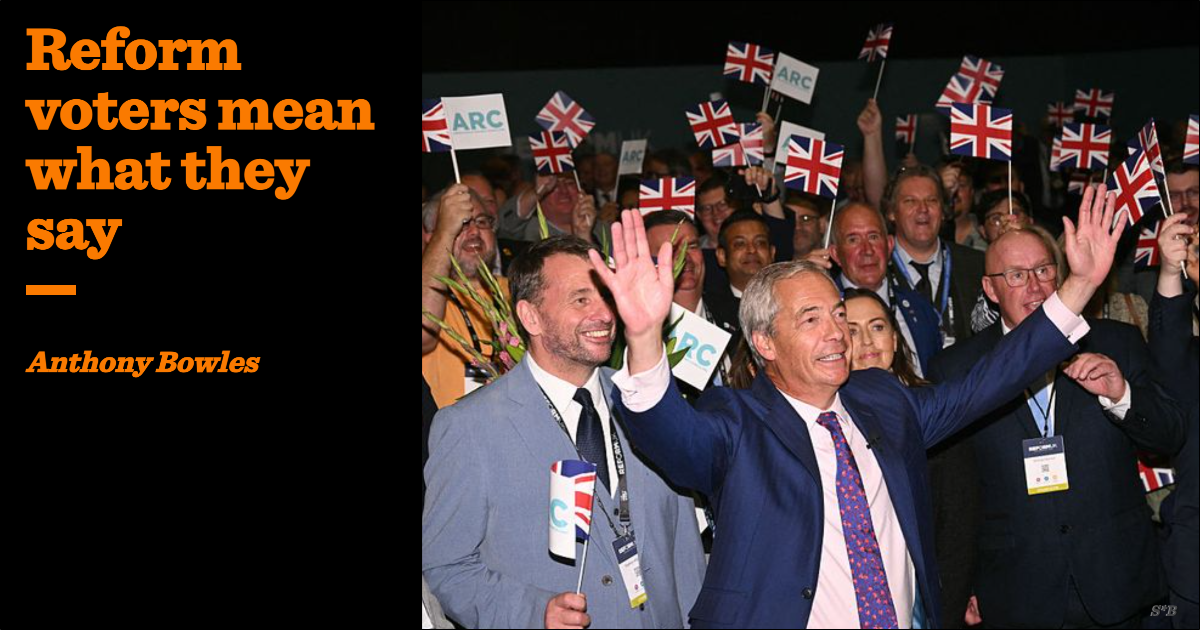
Labour politicians must accept that they do not have the natural right to the nation’s support
Last week was when Keir Starmer decided to call Reform UK’s new immigration policy “racist”, while at the same time insisting that Reform UK’s voters were most definitely not racist. Despite some media cheerleading, this doesn’t seem to have been successful, and perhaps this shouldn’t be a surprise: ITV’s Robert Peston released polling data which showed voters’ views of the party’s policies, leaders and voters moved together — trying to separate them was in the end just too much nuance to communicate.
But they sure did give it their all, with cabinet ministers soon appearing on interview sofas to support Starmer’s attack but explain their commitment that Reform voters were “decent” and certainly not racist. In an interview with LBC, Housing Secretary Steve Reed was adamant: he would not call Reform UK voters racist. Instead, he explained:
There are people that are very upset at the way that they haven’t had a pay rise in 14 years; the economy was broken; their town centre’s run down; their kids can’t get a place to live. They’re angry and they’re looking at Reform because they want to send a signal to the likes of me to get a move on and bring about the change they want to see.
A peculiar absence in his listing of voters’ upsets is, well, immigration. You might say it’s implicit in the absence of pay rises or scarcity of places to live, but that explanation is not something Labour politicians like Mr Reed would acknowledge.
Mr Reed’s version is that if voters were to read the small print they would be horrified to find the party they support has racist policies. He wasn’t the only one — the same day, Chancellor of the Exchequer Rachel Reeves was also on LBC explaining that “people support the Reform Party for all sorts of different reasons, often not even knowing the detail of the policies. But this policy’s a racist policy.”
Support for Reform [is] largely driven by opposition to immigration
This is nonsense. No less a reliable voice of multicultural activism as think-tank British Future reported a year ago that “Reform voters are outliers on immigration”, with 81 per cent backing reductions in immigration numbers; 75 per cent large reductions in immigration numbers and 58 per cent evincing “no sympathy at all for those crossing the Channel”. The same voters put immigration in their Top 3 issues: their support for Reform largely driven by opposition to immigration.
How to explain Reed and Reeves’ inability to see these obvious facts? A good explanation seems to be that it is psychologically easier for them to ignore the facts than to confront their implications. Labour Party politicians and activists seem to depend upon a mental world in which they are the good guys come to save the benighted British people — traditionally from the Tories but now Reform and their racist ways.
In this account, Labour’s role as the good guys is obvious to all, beyond question: the British people are fundamentally “decent” (if dim and herdlike), and instinctively share Labour’s moral vision and recognise Labour as its guardians. If British people sometimes don’t vote Labour it’s only because of Tory (now Reform) lies or at worst “we have failed to deliver”. This mental world leaves little language to describe the widespread existence of voters who don’t think Labour are the good guys, or who simply disagree with their moral vision — and so they have to be assumed away.
The need to defend this fragile mental world leads to a slightly weird soft-totalitarian streak. “Labour values are British values”, the Party’s X account intoned at the start of the Party’s conference, as if the party was the fons et origo of morals in this land. This traces back too; Blair’s 1997 manifesto had it that “New Labour is the political arm of none other than the British people as a whole“.
The acquiescence of Cameron era Toryism to Labour’s moral dominance reinforced this view: the post-Blair generation of Labour politicians fall over themselves to connect themselves to it. To give just one example, Alison McGovern MP has posted: “when I was growing up, if something good happened – not political – anything good – my Dad would describe it as a ‘Labour Gain’”.
But the political events of the past decade have seen a battering of that generation’s certainty about their place as Britain’s good guys. First, the “Tory lies” of Cameron’s government decisively defeated Miliband’s Labour despite the background of dreary, endless austerity. Second, Brexit showed even a solid majority of the “decent” British public could be manipulated into ignoring the good guys’ commands. Third, after years of guerilla warfare, Brexit was not only not defeated but Boris Johnson turned it into a landslide with a narrative which seemed to turn “Labour values” on their head.
In 2024, normal service resumed and the good guys returned to power. But as we know, Labour didn’t win the election except by default, as the Tories collapsed in failure and betrayal. The 15 months since have shown a public simmering with discontent, sometimes bubbling over, and Labour’s mental world struggles to process something supposedly impossible: a plurality of voters supporting not just a Tory party quibbling over practicalities, but a Reform party which openly disdains Labour’s claim to moral superiority.
The “good guys” mental world really can’t process this and grasps after phantoms to explain it away. Online disagreement is ascribed to “bots” — Russian, most likely funded by Putin to assist Farage — because people can’t really believe those things, can they? More serious efforts to undermine the government are driven by unnamed ”foreign billionaires”, whose nefarious business interests seemingly align with closing Britain’s borders to cheap migrant labour.
The drift into paranoia over shadowy forces reflects but also reinforces that soft-totalitarian streak, with mutterings about the need for more media regulation and controls on online speech. After all, if “Labour values are British values”, then those opposing Labour values may well — almost by definition — be considered enemies of the state. Put like that, an attack on the main party of opposition as an enemy, of being “worse than racist”, starts to take on a much harder edge, and the question of whether their voters are included in that judgement becomes all the more pressing.