For most of her life, Thea Maria Carlson did not like fire. Even though she had studied earth systems at Stanford University and knew, intellectually, that burning had an environmental purpose in her home of California, she still wanted nothing to do with it.
In 2015, the Valley Fire consumed a path toward her home in the rugged hills of Sonoma County, destroying small towns along the way. After firefighters extinguished that blaze – before it reached her part of the oak- and redwood-dappled Mayacamas Mountains – her neighbors began talking about how to prepare for the next wildfire. Some suggested they should burn the land themselves to mitigate any future blaze.
Ms. Carlson was unsure.
Why We Wrote This
California has spent decades trying to extinguish fires. But residents here are embracing the long-held Indigenous practice of coming together to intentionally burn land – to reduce the power of wildfires, help the ecosystem, and to transform fear into healing.
She knew that intentional fires were nothing new here; Indigenous people in California burned land for generations, until they were harshly persecuted by the state for doing so. Ranchers and other rural landowners have also long used fire as a way of stewarding their properties. But Ms. Carlson was hesitant to set fire to the land where she lived.

Stephanie Hanes/The Christian Science Monitor
Fellow members of Monan’s Rill, a Quaker-founded intentional community, however, wanted to try it. They eventually agreed to hold what are called prescribed burns on two small portions of their 414 acres – with guidance from a growing coalition of scientists, land managers, and fire officials in the area who believed this practice was important for wildfire resilience and the environment.
These experts pointed out that plants and animals here evolved alongside fire and needed it to thrive. Generations of fire suppression – the philosophy of extinguishing any and all flames to protect people and property – had led to an unhealthy environment, they argued, one that had such a buildup of vegetative fuel that natural wildfires were becoming unnaturally supersized. All but two of the state’s largest wildfires between 1950 and 2023 took place since 2000, according to California government statistics; 10 of those were in 2020 and 2021. And those numbers do not include this year’s devastating Eaton and Palisades fires, which tore through Los Angeles County.
Ms. Carlson did not participate in those first prescribed burns. She watched the smoke from a distance, but was too afraid of fire to get close to the action.
She didn’t realize that this would be the beginning of a transformation: for her, for the land, and for her community. It would only be later, after the devastation and renewal that regularly come with fire, that she would step fully into a sweeping change that is happening across California as more people embrace the need to burn.
Over the past eight years, the number of citizen groups that come together to steward land through fire has increased from one in the state to around 30. Called prescribed burn associations, these groups have seen the number of volunteers skyrocket. New state legislation is making it easier for neighbors to join together and burn, and other laws are starting to allow tribal members to reclaim their traditional use of fire.
As a result, residents are turning one of California’s most disruptive challenges into one of its most powerful sources of connection, care, and love.

California’s long opposition to “controlled burns,” a long-standing Indigenous practice
For people who study fire, it is clear that California’s wildfires today are different from what they once were. The fire season is starting earlier and lasting longer, which some scientists have connected to human-caused atmospheric warming. But crucially, many researchers say, is the changing nature of the blazes. They are hotter and more destructive, and destroy trees and landscapes that once would have survived natural flames.
Fire officials began noticing these shifts as early as the 1980s.
For most of the 20th century, there had been unusually low wildfire activity in the western United States. Deadly wildfires across the northern Rocky Mountains in 1910 had ushered in a policy of “full suppression” firefighting, with new federal-state coordination. The Forest Service argued that even light burning by property owners was damaging for trees and landscapes. In other words, all fire was considered bad, something to be extinguished.
That included fires set by Indigenous people.
For generations, local tribes had burned both as a religious practice and to tend the ecosystem, explains Bill Tripp, director of natural resources and environmental policy for the Karuk Tribe in Northern California.
“It is part of our ways of knowing and doing and learning that using fire in the right ways is part of our responsibility to the natural systems that we depend on,” Mr. Tripp says. Ceremonies incorporating fire took place throughout the year and served unique environmental purposes: attracting deer across a particular waterway, clearing one sort of plant so others could grow, prompting salmon up a river.

Stephanie Hanes/The Christian Science Monitor
In 1911, federal law created new prohibitions on these cultural burns. California had a long history of persecuting Native people. The same law in 1850 that allowed for the enslavement of tribe members and the forced separation of children from their families also prohibited their burns. In 1918, Forest Service officials suggested any Native person found setting a fire should be shot.
By the end of the 20th century, though, some researchers were starting to question this full suppression policy. Researchers had found that some fire was necessary for local species – giant sequoias, for instance – to germinate.
In the 1960s, some officials suggested that a few “controlled burns” might help mitigate wildfire damage. By the 1990s, the Forest Service and the Bureau of Land Management, which are responsible for fire policy within the nearly half of California that is owned by the federal government, were conducting some burns.
The Bureau of Land Management was in charge of one such fire in early July 1999, outside the town of Lewiston, California.
About 250 miles north of San Francisco, the bureau intended to clear brushland ahead of the state’s driest summer month. But as the winds picked up that day, the fire jumped across its control line. Eventually raging across 2,000 acres, the blaze damaged the historic mining town, burning two dozen homes, and quickly stopped the burgeoning effort to intentionally burn forestland.
Firefighting organizations doubled down on suppression, recalls Fred Peterson, a longtime volunteer firefighter and vineyard owner who lives in the mountains overlooking Sonoma County’s picturesque Dry Creek Valley. “The goal was to put it out,” he says.
But then, Sonoma County went through a series of years that many people here simply describe as “apocalyptic.”
It would prompt Mr. Peterson, like Ms. Carlson, to change his relationship with both fire and the land he loves.

Stephanie Hanes/The Christian Science Monitor
A skeptic of controlled burns becomes a believer
There used to be an expected pattern to the fire year in Sonoma County, Mr. Peterson says.
In a hot, dry summer, the flames might begin in late August. They might get more intense in September, or even October. If the dry Diablo winds swept in from the east, he would expect to be on call with the other firefighters of the Geyserville Fire Protection District to respond to blazes sweeping down from the surrounding hills. They prayed for the rainy season to come by late October, so that by November and through the winter and spring, the hills were green and the land relatively fire safe.
But in September 2016, the Sawmill Fire consumed 1,500 acres near the Geysers Geothermal Field, which Mr. Peterson can see across the valley from his house. Smoke sank into the valley. The next year, in October, the Tubbs Fire rushed on hurricane-level winds into the nearby city of Santa Rosa, destroying thousands of homes and killing 22 people. It was declared the most destructive wildfire in California’s history – but only until a year later, when the Camp Fire, north of Ms. Carlson and Mr. Peterson in Butte County, destroyed the town of Paradise, leaving 85 people dead.
Ms. Carlson remembers going to her mother’s house for dinner during this time. When she saw a thin ribbon of smoke curling from a candle, she felt a sense of panic.
Around this same time, the Nuns Fire also burned through Sonoma and Napa counties, destroying some 1,300 structures and killing three people. It swept through the Bouverie Preserve southeast of Santa Rosa.
But there, something stood out.
Two years earlier, the nonprofit Audubon Canyon Ranch had hired a fire ecologist named Sasha Berleman to help organize a prescribed burn at the Bouverie preserve, which it owns.
After years of planning, that burn took place in May 2017, just months before the Nuns Fire. It one of the first prescribed burns done in the region not organized and led by state or federal fire officials.
A native Californian, Dr. Berleman remembers being terrified of the fires that would roll through the increasingly populated hills around her hometown of Temecula, in the southern part of the state. She despaired of the way those hills had transformed from wildlands where she would play into miles of subdivisions; she worried about other ways humans were taxing her state’s environment.

Courtesy of Northern Sonoma County Fire Chief Marshall Turbeville/File
It was only after hearing a talk by a local member of the Pechanga tribe, who described the ways human-set fires could help the landscape, that she started to shift her perspective – both about fire and about the way people could exist in California.
“It sparked an interest in me,” she recalls. “Not only can this process that I was terrified of as a little kid be one of rejuvenation for the land; I’m hearing for the first time that humans have a role in tending the landscape.”
When she surveyed the preserve after firefighters contained the Nuns Fire, she was stunned to see how clearly the theories of her research manifested on the ground.
The fire, she says, had “left these beautiful, intact ecosystems where we had burned. And it had really dramatic, intense fire behavior everywhere else on the preserve – like, right across the line. And it just became this incredible story and talking point and ray of hope.”
She convinced her boss to let her start a fire research and training academy, called Fire Forward, for citizens and local fire officials who wanted to facilitate more intentional burning on the community level. She gave the presentation that convinced Ms. Carlson’s neighbors to burn. She also worked with the chief of the Northern Sonoma County Fire Protection District, Marshall Turbeville, on ways to coordinate and convince residents that intentional burning could be safer than waiting for a wildfire.
For Mr. Turbeville, the approach made sense. He had been fully part of the fire suppression approach when he started work with state and local fire departments in the 1990s. But he had come to believe that firefighters were facing an impossible battle. He and his colleagues were putting out all the fires that were possible to extinguish. But that left fires that couldn’t be stopped, and those burned ever more fiercely.
Fire, he recognized, was a natural process. And stopping that process, he said, was like damming a river – a human intervention that had environmental consequences well beyond what was intended. People were terrified of fire because they only saw the big, scary flames on the news, he believed. But that’s not what a burn needed to be. It was the difference between a flood washing away homes and a trickling creek.

One can’t “control” a fire – Mr. Turbeville didn’t like the term “controlled burn.” But with respect, and care, people could work with fire.
Still, he recognized that prescribed burning was expensive and, under the control of state or federal departments, could be highly regulated. It took years to secure environmental and safety permits to burn on state or federal land, and then it was tricky to find the window where clean air requirements, weather conditions, and personnel availability aligned.
So he was receptive when Dr. Berleman proposed an increase in prescribed burn associations in Sonoma County, where trained citizen “burn bosses” could manage the fire.
These sorts of groups operate across the U.S., with a particularly long history in the Southeast. But until 2017, there were none in California.
“All of my mentors and community from the prescribed fire world told me I was crazy when I started saying that I was going to make prescribed fire a thing in the North Bay Area,” Dr. Berleman says. “You’re surrounded by multimillion-dollar homes. The populations are high. There are roads and infrastructure everywhere. Everyone was telling me, ‘That’s not the place to be trying to get burns on the ground.’”
But given the ferocity of the wildfires in Sonoma County, Mr. Turbeville thought people in his region might be open to this new approach. “There are more and more people who understand the environmental consequences of not allowing a natural process to occur,” he says.
Mr. Peterson was one of them.
The chief had called him shortly after the Tubbs Fire subsided. Mr. Peterson listened as the chief described his feelings of helplessness watching home after home in suburban Santa Rosa explode into flames.
“He says, ‘We can’t keep doing the same thing and expecting different results,’” Mr. Peterson recalls. “I’d never given consideration to prescribed burning. But he finally said, ‘Look, we can either burn it on our terms, or it’s gonna burn on its own time, on its own terms.’”
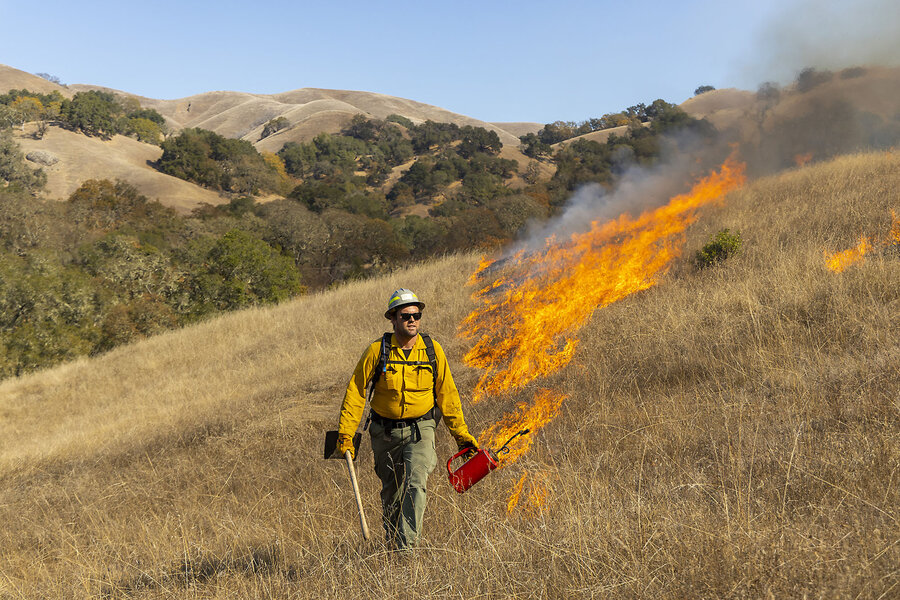
Between the end of 2019 and the middle of 2020, the two men worked together with Ms. Berleman to organize neighbors near Mr. Peterson’s home on Bradford Mountain to burn 30 acres in 3- to 10-acre units. They cut control lines and cleared foliage away from the bases of large trees and power poles. And then, with a combination of volunteers from the community and firefighters, they torched the earth and watched the low, crawling flames consume the underbrush.
That same year, however, fire came for Ms. Carlson’s home.

Courtesy of Northern Sonoma County Fire Chief Marshall Turbeville/File
How prescribed burns increase resilience against wildfire
The official cause of the Glass Fire, which started near a Napa County vineyard on Sept. 27, 2020, is still a mystery. But how it spread is not. Dry conditions and heavy winds swept the fire into Sonoma County, burning tens of thousands of acres as it traveled.
At Monan’s Rill, community members debated whether to evacuate. Ms. Carlson argued that they should leave. Eventually, with Dr. Berleman’s advice, they all did.
The fire swept through the mountains, consuming towering redwoods and gnarled oak trees, and up the steep hills toward Monan’s Rill. It burned 12 out of the 13 homes there – all but Ms. Carlson’s, which was set apart from the others. It destroyed communal structures, as well.
Days later, Ms. Carlson remembers trying to absorb a land charred black and in ruins. She and her neighbors started talking about whether they should even return given its fire risk. They had been dramatically underinsured, she says, and needed to rebuild homes from scratch. It felt daunting.
And then, someone showed her a photo of an area of Monan’s Rill that was still verdant and green, untouched by the wildfire: the land that they had burned intentionally a few years earlier.
It had, she recalls, a profound effect.
“I was like, OK, I think I want to move back to the land. But if I do, I need to learn how to use intentional fire. Because, obviously, that’s what the land needs to be healthy, and it’s what we need to keep the community safe.”
She signed up for a basic firefighting course and started training to pass the physical fitness tests, which included walking 3 miles in less than 45 minutes, carrying 45 pounds. She checked out books about the history of fire on the landscape, researched scientific articles, and listened to podcasts and webinars. And she walked the land.
“There were a lot of places I never walked because they were so thick with brush. But then, when all the brush burned, that first year, you could walk all over the whole 414 acres. And so, it was getting to know the land and seeing the resurrection of the land – this completely black landscape and the green coming back, what things just looked dead but were actually still alive.”
She read the works of an academic named Lenya Quinn-Davidson. A professor at the University of California Agriculture and Natural Resources, Dr. Quinn-Davidson had started the state’s first prescribed burn association in Humboldt County in 2017. She was convinced of the importance of intentional – or “good” – fire. And she had concluded that it would be more effective to mobilize the private landowners who held more than 13 million acres in the state than to fight federal bureaucracy to allow for more burning on federal lands, she explained to interviewers. She also turned her attention to the policies facilitating this effort – and found a newly receptive audience in the California Legislature.
In 2021, California lawmakers passed a bill that changed liability rules to encourage more citizen prescribed burns, essentially creating a burn boss certification process. The next year, they established a claims fund to pay for damages connected to prescribed fires. And the state began to work with Indigenous tribes to restore their ability to conduct “cultural burns” outside of state certification processes.
“We have been experiencing a massive paradigm shift with regard to how the state of California conducts business related to all things wildfire resilience,” says Allison Jolley, director of The Regional Forest and Fire Capacity Program at The Watershed Research and Training Center in Hayfork, California, an organization central to the “beneficial fire” effort in the state.
In 2023, the University of California’s Blodgett Forest Research Station published a 20-year study giving more evidence that prescribed fire significantly increases resilience against wildfire.
And the next year, the Point Fire ignited in Sonoma County, blazing across the mountains – straight toward Mr. Peterson’s home.

Stephanie Hanes/The Christian Science Monitor
“There are neighbors helping neighbors.”
What happened with the Point Fire is similar to what happened after other prescribed burns. Firefighters stationed themselves at Mr. Peterson’s home. They set up positions along the fire lines and roads. And largely because of the area they had burned and cleared four years earlier, they were able to stop the blaze before it did significant damage to Mr. Peterson’s Bradford Mountain community.
Others in Sonoma County noticed this impact, says Mr. Turbeville. And residents in neighboring communities started organizing to set their own fires.
Prescribed burning is not one and done, Mr. Peterson cautions. Even since the Point Fire, flammable brush has grown around the oak trees. Part of living in California is constantly tending the land with fire in mind, he says.
But this effort has a growing number of helpers. Whenever Ms. Carlson, who is now one of dozens of California state certified burn bosses, posts online that she is planning a prescribed burn, she has more people offering to volunteer than she can use. Many drive up from San Francisco or surrounding urban areas, she says. Others live elsewhere in Sonoma County. All are hoping to do something positive for the land.
“Most people in the Bay Area are eager to lean in and experience a sense of healing around reconnecting with fire in a different, positive way, and then also building community around that,” says Dr. Berleman. “Everyone in the community who’s coming out had experienced these traumatic wildfires, and now they have this team of folks they are building relationships with, who are leaning into healing that relationship with fire.”
Spencer Klinefelter, program coordinator for the Central Coast Prescribed Burn Association, says he sees similar interest south of Ms. Carlson and Mr. Peterson. He works around Santa Cruz and sees college students, retirees, old-time ranchers, and even families volunteering together.
On one recent burn, he says, multigenerational ranching families on their all-terrain vehicles worked alongside environmentalist college students and professors, and then with volunteers from the local fire department, all while local tribal members sang traditional prayers to begin the burn.
“There’s a great collective sense that we’re sharing this work,” he says. “It’s been pretty powerful. There’s the traumatic side when people experience wildfire – and there’s the healing side where people come and experience [fire] this way.”
Even Lewiston, the Northern California town that burned in 1999, is considering prescribed burning again.
Miller Bailey, co-director of fire management for The Watershed Research and Training Center, has been talking with landowners there, as part of his work embedding with communities to talk about burning, its benefits, and how to mitigate its risks.
People know that “fire lives on this landscape, and it is coming now,” he says. “So, the landowners, and the folks that are coming to our communities, they are really bought in. And they’re saying, ‘Yes, I want to use this.’”
When they do, he says, the experience goes well beyond expectations. “People are coming together,” he says. “There are neighbors helping neighbors. There’s so much passion. It’s incredible.”
There is still much California needs to do to restore its relationship with this natural force, say those involved with this new approach. But more people are recognizing that if fire destroys, it can also regenerate and rejuvenate, says Ms. Carlson.
On a recent day she walked along the 22 acres of Monan’s Rill that were intentionally burned this summer under her leadership. She had created the burn plan, had studied the ecology, had organized the volunteers and then, carefully, guided the group in igniting the flames.
She points to a spot of charred earth. There, a bright green tuft of grass is growing, healthily, in the August sunlight.