NASA will lose contact with its astronauts for 40 minutes tonight as their spacecraft passes behind the moon.
The Artemis II crew are on their final approach to the lunar surface ahead of this evening’s flyby, which will see them break the record for the farthest distance ever travelled by humans.
As part of the mission, the team will be taking photos and videos of our celestial neighbour and recording their observations.
But there will be a tense 40 minutes when the lunar surface blocks radio signals needed for the Deep Space Network to connect with the spacecraft.
During this time, there will be a communications blackout between mission control and the astronauts.
And it means that if something goes wrong, there is no way the astronauts can contact Earth for help.
‘When we’re behind the moon, out of contact with everybody, let’s take that as an opportunity,’ Artemis pilot Victor Glover previously told the BBC.
‘Let’s pray, hope, send your good thoughts and feelings that we get back in contact with the crew.’
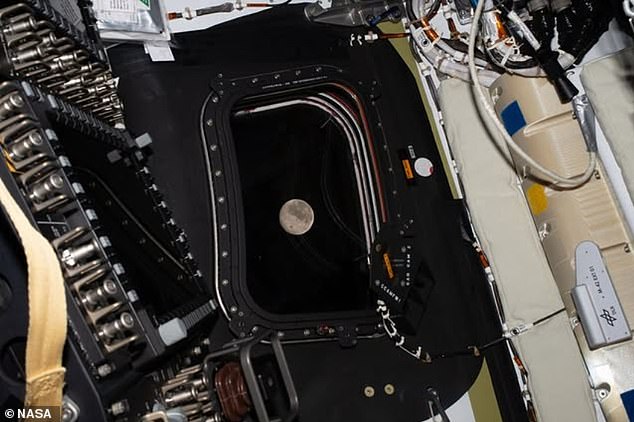
NASA shared this image earlier today with the caption: ‘One last look at the moon before flight day six and your epic lunar flyby, taking you farther into space than humans have EVER traveled’
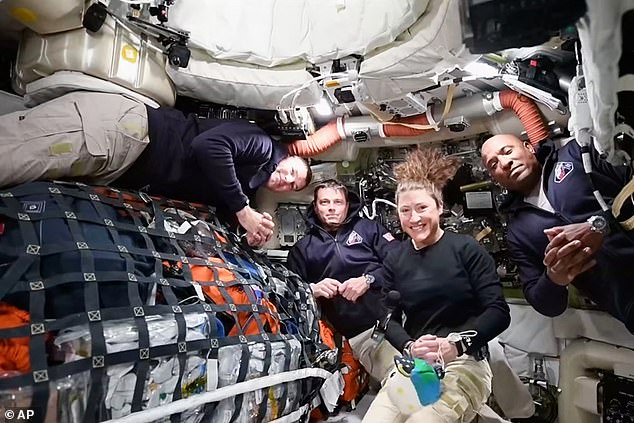
The Artemis II crew, from left, Canadian astronaut and mission specialist Jeremy Hansen, Commander Reid Wiseman, mission specialist Christina Koch and pilot Victor Glover
The mammoth 685,000-mile (1.1 million km) round-trip mission marks the first time humans have been sent to the moon in more than 50 years.
The Orion capsule is currently around 32,000 miles (51,499km) away from the lunar surface, and images taken by the astronauts have already revealed features never previously seen by human eyes.
At around 1:56pm ET (6:56pm UK time) the crew are expected to surpass the record previously set by the Apollo 13 mission in 1970 for the farthest humans have ever travelled from Earth.
While the Apollo crew travelled 248,655 miles (400,171km) from Earth, Artemis II will reach a maximum distance of 252,757 miles (406,772km).
The team will then commence seven hours of moon observations and will be able to get a close look at both the near and far sides of the moon.
Since room at the windows is limited, the crew will divide in pairs with two observing for 55 to 85 minutes while the other pair exercises or works on other tasks.
The most terrifying moment will come at 6:47pm ET (11:47pm UK time) when mission control will lose communication with the crew as Orion passes behind the moon.
During this time the astronauts will make their closest approach to the moon. At this distance, it will appear about the size of a basketball held at arm’s length.
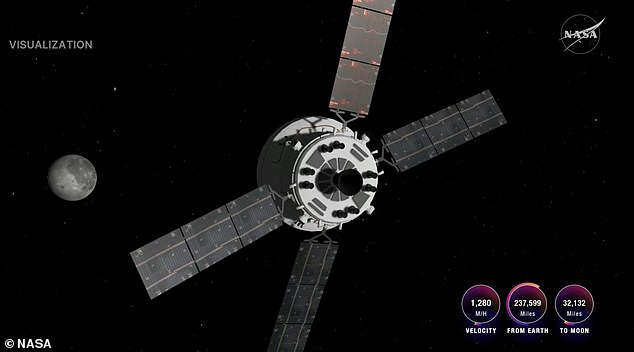
The Orion capsule is currently around 32,000 miles (51,499km) away from the lunar surface, as this visualisation shows
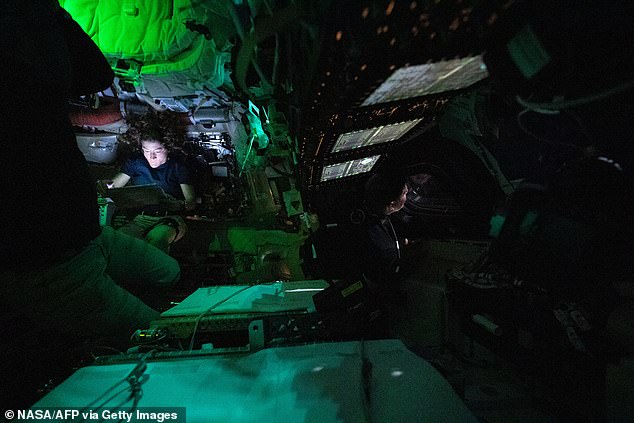
NASA astronaut Christina Koch illuminated by a screen inside the darkened Orion spacecraft. For 40 minutes of the flyby, the crew will lose contact with Earth
Judd Frieling, ascent flight director of the mission, appeared unfazed when discussing the impending loss of signal at a briefing yesterday.
Rather than using risky engine burns to propel them back to Earth, the crew are relying on the moon’s gravity to slingshot them back.
Mr Frieling said there will be no ‘loss of control’, adding: ‘We absolutely know physics is going to take them back to us.’
NASA’s mission control should re-acquire communication with the astronauts at 7:27pm ET (00.27 UK time).
The crew will have another two hours of flyby observation before they begin transferring imagery and data to the ground.
This is not the first time communications blackouts have been planned as part of a mission.
Similar events occurred during the Artemis I and Apollo missions and are expected with the current communications infrastructure.
So far the mission has run relatively smoothly – except for a few issues with the toilet, which have now been sorted.
Once the capsule completes its flyby, it will take another four days to return to Earth.
During this time, the astronauts will conduct key safety demonstrations, including testing procedures designed to shield the crew against dangerous radiation from solar flares.
As Orion approaches Earth, it will separate key components before plunging into the atmosphere at speeds of about 25,000mph (40,233kph) and splashing down in the Pacific Ocean.
The voyage aims to pave the way for a moon landing in 2028 which, if successful, will be the first time humans have set foot on the moon since December 1972.