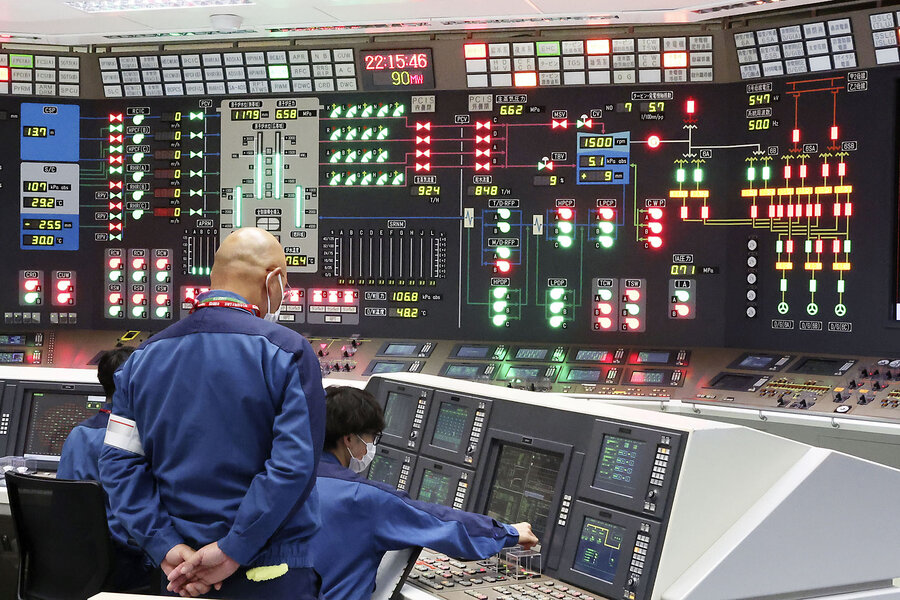
When Japan restarted one of the seven reactors at the largest nuclear plant in the world in January, many of the locals from the nearby village of Kariwa – population, about 4,200 – were uneasy about it. Not the mayor, though.
Shinada Hiroo expresses unwavering trust in the people who run the nuclear facility, reflecting a changing attitude toward nuclear energy in Japan.
Fifteen years ago Wednesday, a powerful earthquake and resulting tsunami triggered the nuclear emergency at Fukushima. Japan’s government responded by shutting down all 54 of the country’s nuclear reactors. And in 2012, it even decided to phase out nuclear power generation. But today, with Prime Minister Takaichi Sanae leading the charge, Japan is slowly putting nuclear power at the center of its national energy policy.
Why We Wrote This
Japan turned off all of its nuclear reactors after the 2011 nuclear disaster at Fukushima. Now, the government – and the public – has reversed course. The country is returning to nuclear energy, but there’s still some skepticism.
Some remain skeptical. But the restart of reactor No. 6 at the Kashiwazaki-Kariwa nuclear plant is a key moment for Japan’s turn toward nuclear energy once again.
“They are colleagues just like the village’s farmers and factory workers,” Mr. Shinada says emphatically, referring to the personnel and executives at the Kashiwazaki-Kariwa Nuclear Power Station. The sprawling plant, operated by Tokyo Electric Power (Tepco), is located in Kariwa and the city of Kashiwazaki, about 140 miles northwest of Tokyo.
Mr. Shinada, who is a former amateur race car driver, is one of the few local leaders who has maintained a long-term relationship with Tepco. The company lost considerable confidence among the Japanese public after the meltdown at Tepco’s nuclear facility at Fukushima in March 2011.

“Though some Tokyo Electric executives used to be called ‘emperors,’ the company has paid more attention to local matters,” Mr. Shinada says.
This island nation, which is roughly the size of Montana, has one of the biggest economies on Earth. And Japan wants a low-carbon option to continue powering its growth for the 21st century, including power-hungry data centers that drive artificial intelligence. Nuclear energy is increasingly seen as a good option.
In a poll by Jiji Press news agency from December, 45% of respondents said they support rebooting Japan’s nuclear reactors that were mothballed nearly 15 years ago. Another survey by the Asahi newspaper in 2016 found that just 31% supported the restart, with 54% opposed to it. Now, the process is well underway, with 15 out of a total of 33 operable reactors back online.
But there are still some real concerns.
One of the lessons from Fukushima, says Kondo Yukari, a city council member from Kashiwazaki, is “to bear in mind that we might be hit by an unanticipated natural disaster.” Japan is an earthquake-prone country with more than 100 active volcanoes, and the government warns that a mega-earthquake could hit at any time off the Pacific coast. Ms. Kondo says that is why the country has imposed stricter regulations on nuclear plants, with stronger safety measures, improved infrastructure, and evacuation plans.
At the same time, she sees why there is a growing interest in nuclear energy. “We need to ensure stable power sources and [restarting reactors] is also very important in light of decarbonization.”

The Kashiwazaki-Kariwa facility is in Niigata prefecture, where some residents worry that the plan to restart the reactor there was carried out hastily.
Yoshida Ryusuke is a potter whose 150-year-old traditional wooden house is less than two miles from the No. 6 reactor. He is concerned that Niigata’s governor faced intense pressure from federal officials to get the reactor back online without a proper evacuation plan for the local population.
“We would be abandoned” in the event of a serious nuclear accident, Mr. Yoshida says. “That itself ignores human rights, to begin with.”
Saikawa Masao, the head of the Kashiwazaki Chamber of Commerce and Industry, understands people were “deeply shocked” by the Fukushima accident.
But 15 years later, Mr. Saikawa says the Kashiwazaki-Kariwa nuclear facility is an important part of the local economy, including job creation. About 74% of the 6,640 people working at the plant are residents of Niigata prefecture, according to Tepco.
Before the incident at Fukushima, nuclear plants generated about 30% of Japan’s electricity. Currently, that figure is about 9% – and the government wants to make it 20% by 2040.
Prime Minister Takaichi came into office vowing to expand Japan’s nuclear power industry. In a speech to Parliament in February, she vowed to develop and deploy “next-generation advanced reactors” to replace those slated for decommissioning.
The return to nuclear power has not been without hiccups.
Just hours after the restart at the Kashiwazaki-Kariwa station in January, an alarm was triggered because of an apparent malfunction and operations were halted. The reactor was reactivated in early February.
Akazawa Ryosei, Japan’s minister of economy, trade, and industry, says the restart of the No. 6 reactor is a “crucially important step.”
It is also a key moment for Tepco, which is struggling to get out from under heavy debt. The company’s total liabilities are 11.9 trillion yen (about $75 billion). In January, the company said it is looking at a projected net loss of 641 billion yen ($4.1 billion) for the current financial year, due in part to surging costs related to decommissioning work at the Fukushima plant.
Tepco is trying to build trust at the local level, sending company officials to meet with people who live and work near the Kashiwazaki-Karima plant.
“They visit each of our group’s 1,800 member companies twice a year,” says Mr. Saikawa from the chamber of commerce. “In addition, they are actively involved in volunteer work as members of this community,” he says.
Some community members are still wary about the future.
“We should not rely on the nuclear plant in the long run,” says Sakai Noriaki, the owner of a cafe and a popular gathering spot in Kashiwazaki. Though, he admits that some of his customers are Tepco employees and that people he knows have relatives who work at the plant.