German prosecutors are investigating a 100-year-old man on suspicion he served as a Nazi camp guard and took part in executions of prisoners during World War II.
Authorities in the western city of Dortmund allege the crimes took place between December 1943 and September 1944.
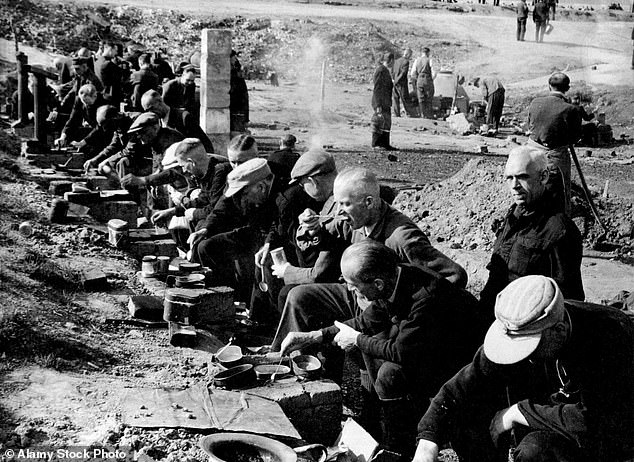
The man is said to have served at the hellish prisoner of war Stalag VI-A camp in Hemer, western Germany, which held at least 100,000 inmates, mostly from the Soviet Union, but also several British, Polish and French soldiers.
Thousands died in the camp from inhumane conditions like overcrowding, poor sanitation, vermin, starvation and rampant diseases such as dysentery and tuberculosis.
Other inmates were savagely killed by guards.
Surviving prisoners in the war camp were severely malnourished, as they were only given one serving of bread a day while also being forced to carry out strenuous labour.
The infamous camp went on to inspire WWII film ‘Hart’s War’, starring Bruce Willis.
Prosecutor Andreas Brendel told local media that the investigation was still ongoing but that no more information would be released for the time being.
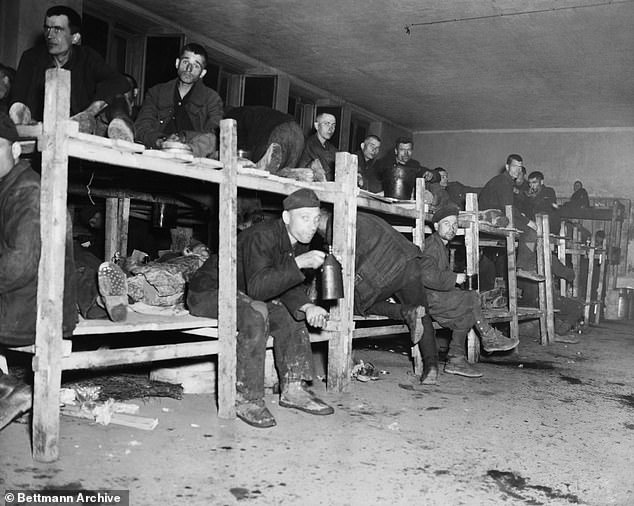
German prosecutors are investigating a 100-year-old man on suspicion he served as a prison guard at a Nazi camp in Hemer, Germany. Pictured: The interior of the ‘hospital’ room at the Nazi prisoner of war camp near Hemer, Germany
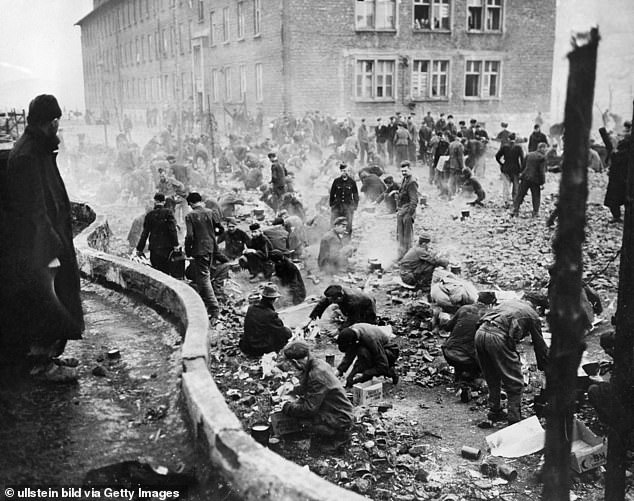
The man is said to have served at a hellish prisoner of war camp in Hemer, western Germany , which held at least 100,000 inmates
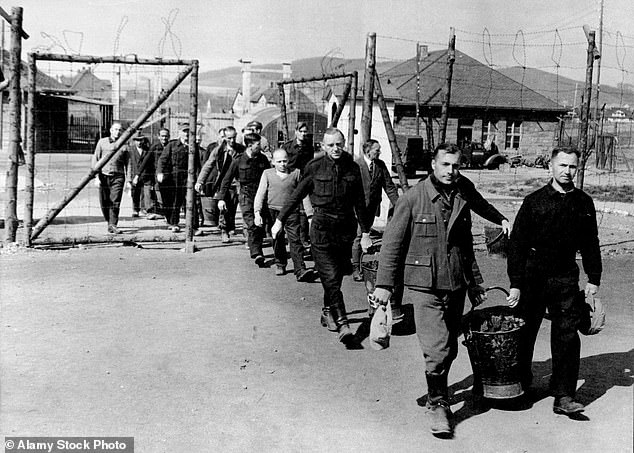
Thousands died in the camp from inhumane conditions, while others were savagely killed by guards
The case was opened by the Central Office of the State Justice Administrations for the investigation of war crimes crimes.
After the initial investigations were completed, the case was moved to the Dortmund public prosecutor’s office, which is responsible for the prosecution of Nazi crimes in the region.
The Central Office was founded in 1958 and has conducted nearly 8,000 preliminary investigations into Nazi crimes.
Several trials of Nazi camp staff have been held in recent years, spurred by the 2011 conviction of former Sobibor death camp guard John Demjanjuk, despite no proof he had directly killed anyone.
The trials allow people who helped a Nazi camp function to be prosecuted as an accessory to the murders without there being direct evidence that they participated in a specific killing.
Charges of murder and being an accessory to murder aren’t subject to a statute of limitations under German law.
However, time is running out 80 years after the end of the war.
Josef Schuetz, a former guard sentenced in June 2022 to five years in prison, died less than a year later at the age of 102.
The investigation is still ongoing
In April, an alleged former guard at the Sachsenhausen concentration camp near Berlin died before he could face court to answer charges of being complicit in the murder of more than 3,300 people.
More then 200,000 people were held at Sachsenhausen, just north of Berlin, between 1936 and 1945.
Tens of thousands died of starvation, disease, forced labor, and other causes, as well as through medical experiments and systematic SS extermination operations including shootings, hangings and gassing.
Exact numbers for those killed vary, with upper estimates of some 100,000, though scholars suggest figures of 40,000 to 50,000 are likely more accurate.
Earlier this year, a former Nazi death camp worker dubbed the ‘Secretary of Evil’ died aged 99 in Germany two years after facing justice for aiding more than 10,000 murders.
Just before her death on January 14, Irmgard Furchner, who was a secretary to the SS commander of the infamous concentration camp Stutthof, had failed in her bid to overturn a conviction for being an accessory to thousands of murders in northern Poland during WWII.
Germany ‘s Federal Court of Justice upheld the conviction given to Furchner in August last year.
An estimated 63-65,000 people, made up of Jewish people, political prisoners, accused criminals, gay people and Jehovah’s Witnesses, were slaughtered at the camp between 1939 and 1945.
She was accused of being part of the apparatus that helped the camp near Danzig, now the Polish city of Gdansk, function.
She was convicted of being an accessory to murder in 10,505 cases and an accessory to attempted murder in five cases.
At a federal court hearing in Leipzig last July, the Nazi’s lawyers tried to cast doubt over whether she could really be considered an accessory to the atrocities committed at the camp, and whether she had been fully aware of what was going on.
She was tried in a juvenile court as she was 18 and 19 at the time of the alleged crimes, and the court couldn’t establish beyond a doubt her ‘maturity of mind’ then.
But the court ruled that Furchner ‘knew and, through her work as a stenographer in the commandant’s office of the Stutthof concentration camp from June 1, 1943, to April 1, 1945, deliberately supported the fact that 10,505 prisoners were cruelly killed’.
The killings were by gassings, by hostile conditions in the camp, by transportation to the Auschwitz death camp and by being sent on death marches at the end of the war.