One in ten people using fat jabs Wegovy and Ozempic are ‘non-responders’ who fail to lose a significant amount of weight, trials reveal.
An estimated one in 50 UK adults now use fat jabs with demand soaring since 2023 when the National Institute for Health and Care Excellence (Nice) approved Wegovy for weight loss on the NHS.
The approval was based on clinical studies which showed a weight reduction of 15 to 20 per cent.
The drugs were hailed as a ‘game-changer’ as they helped people lose weight when traditional dieting had not worked, leading to shortages in pharmacies and a rise in illicit online prescribers.
But for some, the injections have not proved the miracle they were hoping for.
When Samantha Jess was prescribed Ozempic to treat diabetes in 2020, she was told it would drown out the ‘food noise’ and that she could lose up to 10 per cent of her 16-stone body weight.
‘I thought, “oh brilliant, I’ve been given a helping hand by the doctors”,’ she told the Sunday Times.
‘I thought Ozempic was going to do something magical.’
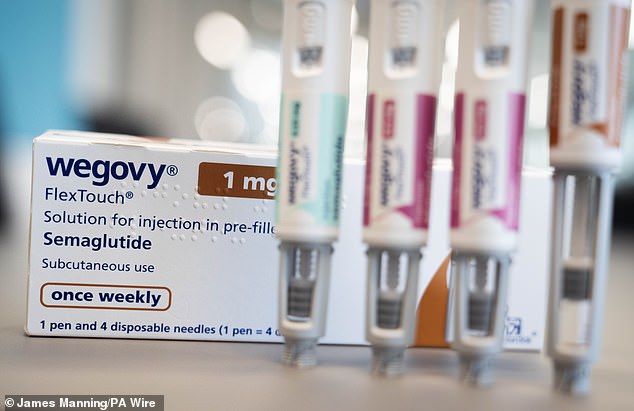
An estimated one in 50 UK adults now use fat jabs with demand soaring since 2023 when the National Institute for Health and Care Excellence (Nice) approved Wegovy for weight loss on the NHS
But eight months later, despite injecting herself with the GLP-1 medication once a week, Jess, 52, had not lost any weight.
‘Nothing was happening, I was still 16 stone. In fact, I was putting weight on,’ she says.
‘I still wanted to eat. It didn’t take away the food noise, I’d still order a takeaway and think, “I’m on Ozempic, how is this even possible?:’
Jess believes she is what scientists classify as a ‘non responder’ – someone whose brain and body does not respond to semaglutide, the active ingredient found in Wegovy and Ozempic.
Treatments such as Wegovy and Ozempic mimic glucagon-like peptide-1 (GLP-1), a natural hormone produced in the gut which regulates blood sugar and appetite.
Released after eating, it induces feelings of fullness and reduces hunger by acting on the brain.
Professor Lora Heisler, an obesity researcher at Aberdeen University, said: ‘Obesity is not one disease and it’s not caused by one thing, it’s a mix of different biological mechanisms.
‘GLP-1 based drugs target only one of those mechanisms, so they can work extremely well for many people, but not for everyone.’
Dr Marie Spreckley, a specialist in weight management research at Cambridge University, believes there is ‘a spectrum of response’.
A lesser mentioned finding from clinical trials is that one in ten people like Jess lose less than 5 per cent of their body weight.
Some scientists believe that weight loss is influenced by ‘metabolic defence’.
This refers to the body’s natural survival response when calorie intake is reduced, which makes it protect energy stores and lower energy expenditure, limiting the amount of weight that is lost.
Professor Heisler said it is often down to genetics, adding: ‘We’re all built differently and some people have stronger, metabolic, protective mechanisms than others.’
In July last year, after years of expensive exercise plans and on-off dieting, Niamh Shackleton, 29, used an online private prescription service to begin treatment with Wegovy.
Niamh, who is 5ft 3in and a dress size 14, says she met the BMI criteria.
She had always been ‘very conscious’ of her weight, and began with a low-dose once-weekly injection and increased gradually to 2.4mg.
‘I remember telling my friends not to worry, that I wouldn’t make myself super skinny,’ she said.
‘I thought the weight was going to fall off really quickly and that I’d have to be careful not to overdo it, but that didn’t really happen.’
Niamh lost approximately one stone over the course of five months.
‘I thought I’d lose double that,’ she says.
‘I thought the weight would start dropping off as soon as I started taking the jabs.’
She says the medication did help to suppress her appetite, especially her sweet tooth but her diet didn’t really change.
She was also recovering from a knee injury, so didn’t keep an exercise routine.
‘I was a bit naive to be honest. They always say it’s not about perfection, it’s about consistency, so I was hoping that the odd pizza and wine night wasn’t going to be detrimental to my progress,’ she added.
Inconsistency with taking any medication will reduce its efficacy and GLP-1 drugs are no different. Some people experience stronger side effects, such as nausea and abdominal pain, making them more likely to skip doses.
The touting of weight-loss jabs as a miracle cure has meant the likes of Ozempic and Wegovy are considered a silver bullet and have been ‘de-medicalised’, says Dr Spreckley.
But she warned: ‘GLP-1 receptors are just an aid to dieting; they make sticking to a diet easier but the usual rules of eating protein and engaging in resistance training still apply. It’s not magic.’